

You check competitor listings on Monday, update a spreadsheet, and tell the category manager that prices look close. Later, someone shares a cheaper offer you missed. Was it available all week, limited to another region, or visible only to members? Your spreadsheet can't answer because it records prices without recording the conditions under which anyone saw them.
A price monitoring API should resolve that uncertainty, not automate it. The engineering challenge is turning returned values into comparable observations, then turning validated observations into decisions you can explain.
Why Price Monitoring APIs Matter Before You Write Code
Consider a category manager who checks familiar competitors each Monday. The same products appear close to parity, so nobody investigates further. When a customer points out a cheaper listing, the team discovers that its checks never included the relevant seller or shipping destination.
That's a hypothetical scenario, but the underlying price dispersion is well documented. In research covering 18 months of consumer-electronics listings, the highest listed product price averaged 57% above the lowest, while purchasing from a randomly selected retailer cost about $31 more on average than purchasing from the lowest-price retailer, according to research on persistent online price dispersion.
Those findings aren't a forecast for your catalog. They establish why assuming that identical products have similar online prices is a weak foundation for competitive analysis.
Define the decision before collecting data
Start with a question someone can act on. A buyer looking for procurement savings needs different comparisons from a retailer evaluating whether a competitor's promotion threatens margin.
Translate that question into collection requirements:
- Relevant sellers include merchants your customers would realistically consider, not every listing that happens to match a product name.
- Comparable offers distinguish product condition, fulfillment, eligibility, and delivery terms.
- Useful history establishes whether a gap persists rather than preserving only the latest fetched value.
- Accountable outputs let an analyst trace a recommendation back to its underlying evidence.
A practical guide to competitor price intelligence can help define the commercial scope before engineers commit to extraction rules.
Practical rule: Don't approve a monitoring project until someone can describe what decision a confirmed price gap should change.
The deliverable isn't a scraper that returns a number. It's a pipeline with a defined comparison unit, controlled collection context, validation gates, historical storage, and deliberate routing rules.
Keep collection and repricing separate. A monitoring system should be able to report a meaningful competitor change without assuming your business should copy it. That separation makes the system useful before automated pricing is justified.
Designing the Data Model and Observation Context
Use a SKU or product variant as the comparison unit, not a URL. A page can contain several variants, and a redirected address doesn't necessarily mean the underlying offer changed.
Maintain a product catalog separately from retailer offers. Your internal product identifier represents what you're comparing; the offer record identifies who sells it, in what condition, and under which commercial terms.
Core Fields for a Price Observation
| Field | Purpose | Why It Matters |
|---|---|---|
| Product and variant identifiers | Identify the exact comparison unit | Prevents mixing sizes, capacities, or configurations |
| Offer URL and seller | Locate the listing and merchant | Separates marketplace sellers from the host retailer |
| Currency, list price, sale price | Preserve displayed monetary values | Distinguishes reference pricing from the available offer |
| Promotion and eligibility | Record coupons, membership, and conditions | Prevents conditional discounts becoming universal prices |
| Shipping, fees, and tax basis | Describe the shopper's effective cost | Supports like-for-like commercial comparisons |
| Availability and delivery promise | Preserve purchase conditions | Separates an available offer from an unavailable listing |
| Observation timestamp | Record when collection occurred | Supports freshness checks and historical alignment |
| Country, region, shipping destination | Identify geographic context | Prevents comparisons across incompatible markets |
| Session state and device profile | Describe the viewing conditions | Supports investigation of contextual differences |
| Validation status and match confidence | Expose quality judgments | Allows downstream consumers to reject uncertain records |
| Retry count and observation age | Describe collection health | Makes degraded or stale coverage visible |
| Evidence reference and parser version | Connect results to their extraction history | Supports debugging and reprocessing |
Use explicit states for missing information. Unknown shipping cost isn't free shipping, and an unavailable promotion field doesn't prove that no promotion exists.
Store money using decimal-safe representations rather than binary floating-point arithmetic. Preserve the displayed currency and original price text alongside parsed values so that a parsing correction doesn't require another collection run.
Separate evidence from interpretation
Keep raw observations immutable. Write normalized prices into a derived layer that records the transformation version, tax convention, currency-conversion basis, and promotion treatment.
That separation lets you recompute effective prices when business rules change. It also prevents a later normalization fix from silently rewriting what the retailer originally displayed.
For product matching, distinguish identical, equivalent, bundle, and refurbished offers. Don't hide those categories inside a confidence score: an confidently matched bundle still isn't an identical standalone product.
Treat the schema as an API contract. Consumers should receive enough context to decide whether observations belong in the same comparison, rather than inheriting undocumented assumptions from the extraction worker.
Choosing a Collection Stack and Wiring the API Calls
Choose the collection layer according to what your team can maintain. Owning browser infrastructure gives you control, but it also means owning browser updates, session behavior, rendering failures, and operational diagnosis.
A managed service changes that responsibility boundary. It doesn't remove your obligation to verify that the returned page contains the intended offer.
Compare ownership boundaries
| Approach | What your team owns | Main trade-off |
|---|---|---|
| In-house | Proxies, browsers, extraction, scheduling, validation | Detailed control with substantial maintenance responsibility |
| Managed web data API | Integration, extraction interpretation, downstream pipeline | Faster integration with provider-specific behavior and limits |
| Hybrid | Scheduling, schemas, validation, storage; outsourced transport and rendering | Infrastructure relief while retaining decision logic |
For a production monitoring system, the hybrid approach is a useful default to evaluate. Keep business semantics in your code while treating transport and rendering as replaceable dependencies.
Use this diagram to identify the collection components you're choosing to own or delegate.
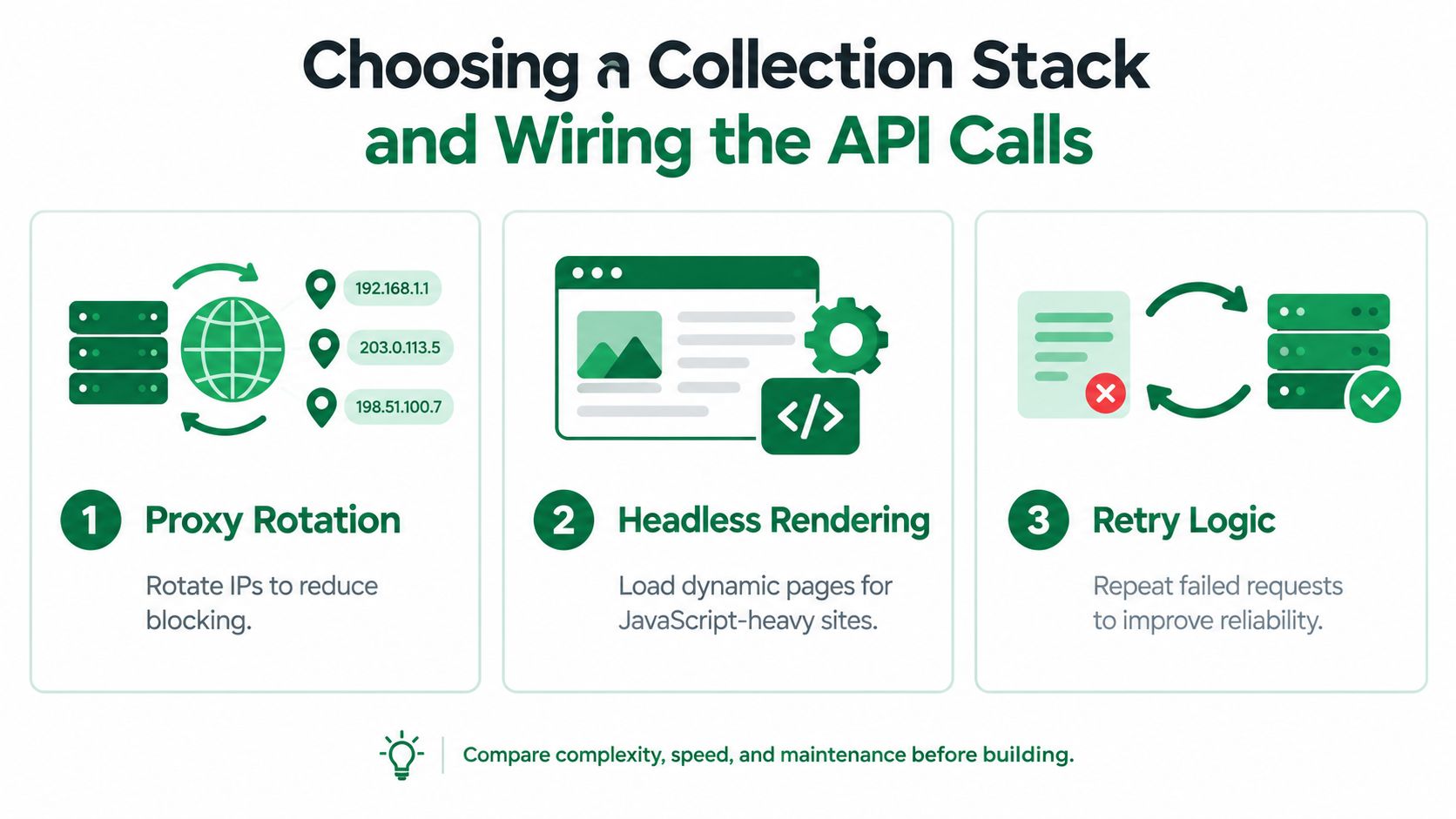
Evaluate candidate APIs against representative pages, including variant selectors and destination-dependent offers. Begin with direct HTTP collection where the required evidence is present; introduce browser rendering when the observation requires JavaScript execution or interaction.
The data extraction API integration guide is useful background when defining that boundary. For a domain-specific documentation comparison, Wine Labs' fine wine data API reference is another resource to inspect while drafting your own consumer-facing contract, without assuming it provides the same collection capabilities.
Keep provider details behind an adapter
Don't scatter provider payloads throughout your scheduler. Build a small adapter that translates your collection intent into the provider's documented request format.
This Python pattern illustrates the boundary. The adapter functions are application-owned interfaces, not undocumented vendor SDK methods.
def collect_offer(adapter, job):
    response = adapter.fetch(
        target=job.url,
        mode=job.collection_mode,
        country=job.country,
        context=job.observation_context,
    )

    if not response.ok:
        adapter.classify_failure(response, job)
        return None

    return adapter.extract_candidate(response, job)
The adapter should distinguish transport failure, unsuccessful target responses, and successful responses containing unusable content. A successful HTTP status doesn't establish that a product price was collected.
Before committing, test whether the provider returns target status, evidence, requested geography, and actionable error categories. Review its Python, Node.js, or cURL examples against the same test pages. Integration convenience matters, but failure visibility determines whether you can operate the pipeline.
Detecting Real Price Changes and Deduplicating Observations
A changed number is a candidate change, not a confirmed market event. A seller substitution, default-variant reset, or expired coupon can produce a different value without representing the comparison your analyst intended.
Validate candidates before admitting them into the trusted observation series. Preserve failed responses as diagnostic evidence, but don't let them influence price baselines.
Validate identity before magnitude
Check the product identifier and selected variant first. Then verify currency, required monetary fields, numeric parsing, and the expected page structure.
The German Federal Statistical Office's methodology identifies movements exceeding 400% upward or 80% downward from the previous observation as implausible and discusses confidence-interval-based anomaly checks in its automated price collection methodology. Treat those thresholds as an anomaly-screening reference, not universal retail alert settings.
Your own plausibility rules should reflect product categories and known commercial behavior. A suspicious movement belongs in quarantine until you can explain it; it shouldn't be discarded without review or accepted solely because it parses.
- Retry transient failures such as interrupted connections or incomplete rendering, using bounded exponential backoff with jitter.
- Quarantine semantic failures such as a currency mismatch, contradictory product identifiers, or a price extracted from an unrelated recommendation.
- Escalate structural failures when a retailer-wide parser change affects multiple offers, rather than retrying each listing indefinitely.
Separate duplicate delivery from unchanged prices
Deduplicate repeated processing of the same collection attempt using an idempotency key. This prevents a retried queue message from creating duplicate observations.
Don't erase legitimate later checks merely because the price is unchanged. Those observations establish continued coverage and support confirmation logic. If storage requires compaction, preserve observation counts, coverage periods, and evidence references.
An unchanged price is useful evidence. A duplicated message isn't.
For detection, compare candidates only within the same offer and context series. Require a subsequent valid observation or a configured persistence window before promoting a candidate into a confirmed event.
Track transitions explicitly: pending, confirmed, rejected, or unresolved. A pending decrease followed by an extraction failure remains unresolved; the failure doesn't confirm that the decrease persisted.
This stateful approach costs more implementation effort than comparing adjacent rows. It also gives analysts an explanation when an apparent discount never becomes an alert, instead of leaving them to reverse-engineer a missing notification.
Scheduling Checks Within Rate Limits and Geo-Targeting
Spend requests according to decision value and repricing velocity. Frequently repriced or commercially important products may warrant sub-daily collection, while slower-moving long-tail products can use daily or weekly checks.
Set a freshness objective for each product group. Schedule against that objective rather than repeatedly scanning the entire catalog with an undifferentiated cron job.
Build a queue that can slow down safely
Use queued jobs carrying a due time, retailer, observation context, priority, and collection mode. Enforce provider-wide concurrency limits alongside retailer-specific limits so one difficult destination doesn't monopolize workers.
- Spread scheduled work across the collection window instead of releasing the whole catalog simultaneously.
- Honor throttling signals and provider retry guidance before admitting more work.
- Reduce concurrency when latency and transient failures rise together.
- Expire obsolete jobs when a newer scheduled observation supersedes them, while recording the resulting coverage gap.
The practical distinction between delaying, rejecting, and retrying requests is covered in this API throttling guide. Keep retry traffic inside the same request budget as scheduled work.
This scheduling diagram provides a useful operational summary.
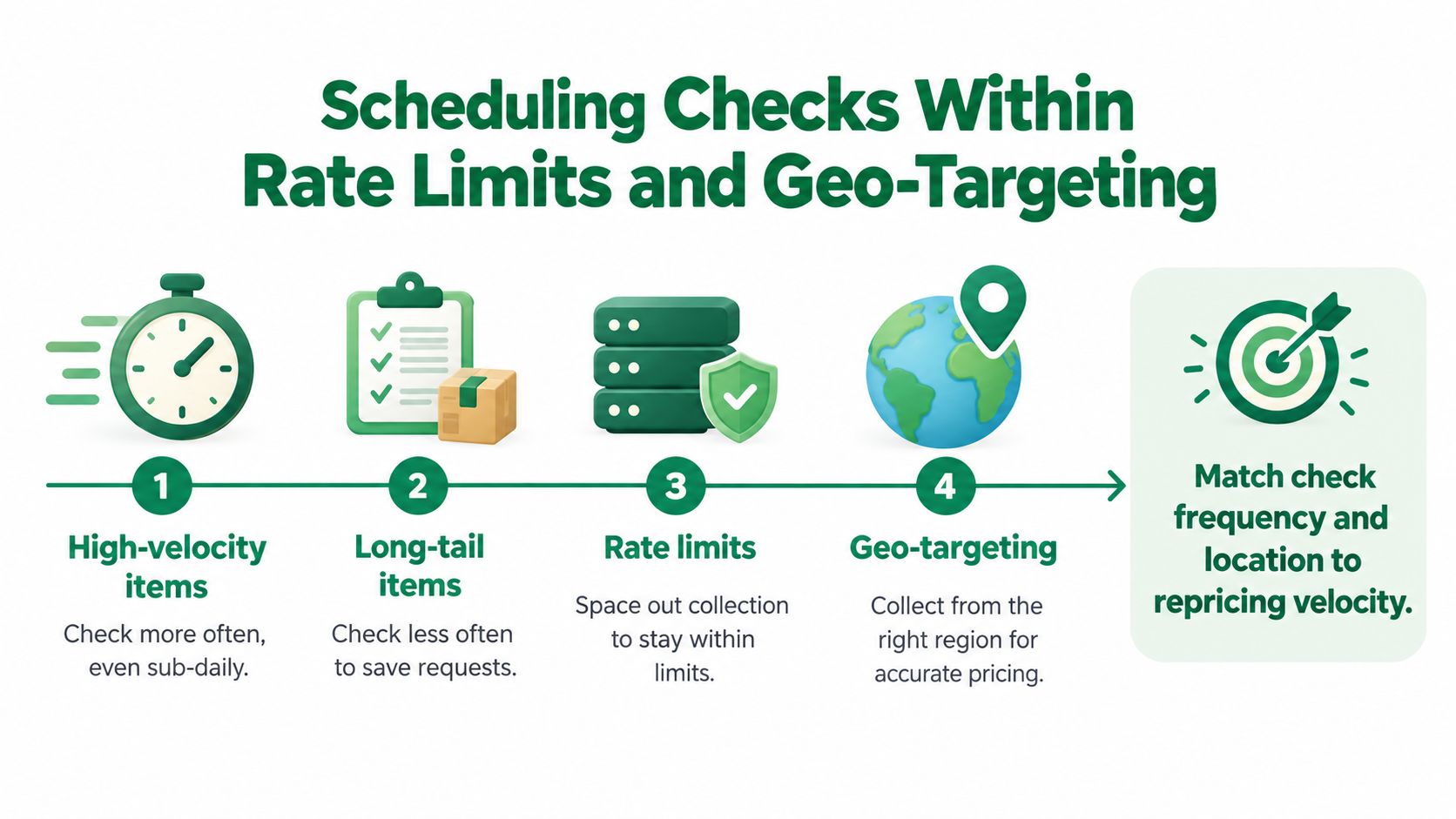
Control geography and session differences
Research using daily Amazon Fresh observations in New York City and Los Angeles found average absolute differences of approximately 16% to 22% for identical products, as documented in the study of geographic online price dispersion. That finding supports location-specific collection, not an assumption that every retailer varies prices similarly.
For a kitchen appliance, define a fixed panel of destination cities and collect comparable observations within the same time window. Keep the product selection, session policy, and device profile stable across that panel.
A proxy country alone doesn't prove which market the retailer served. Check the displayed delivery destination or another available market indicator, and record discrepancies between requested and observed location.
To investigate possible personalization, vary a single context dimension while holding the others stable. Compare standardized logged-out sessions before introducing authorized account-based checks. Repeat unexplained differences before labeling them contextual, and don't call them personalized solely because separate browser sessions returned different prices.
Routing Alerts Through Webhooks, Storage and Analytics
Publish confirmed events, not every observation. The event stream should represent changes that passed your quality and persistence rules, while the observation store retains the evidence needed to revisit those judgments.
Use the pipeline diagram to keep those responsibilities distinct.
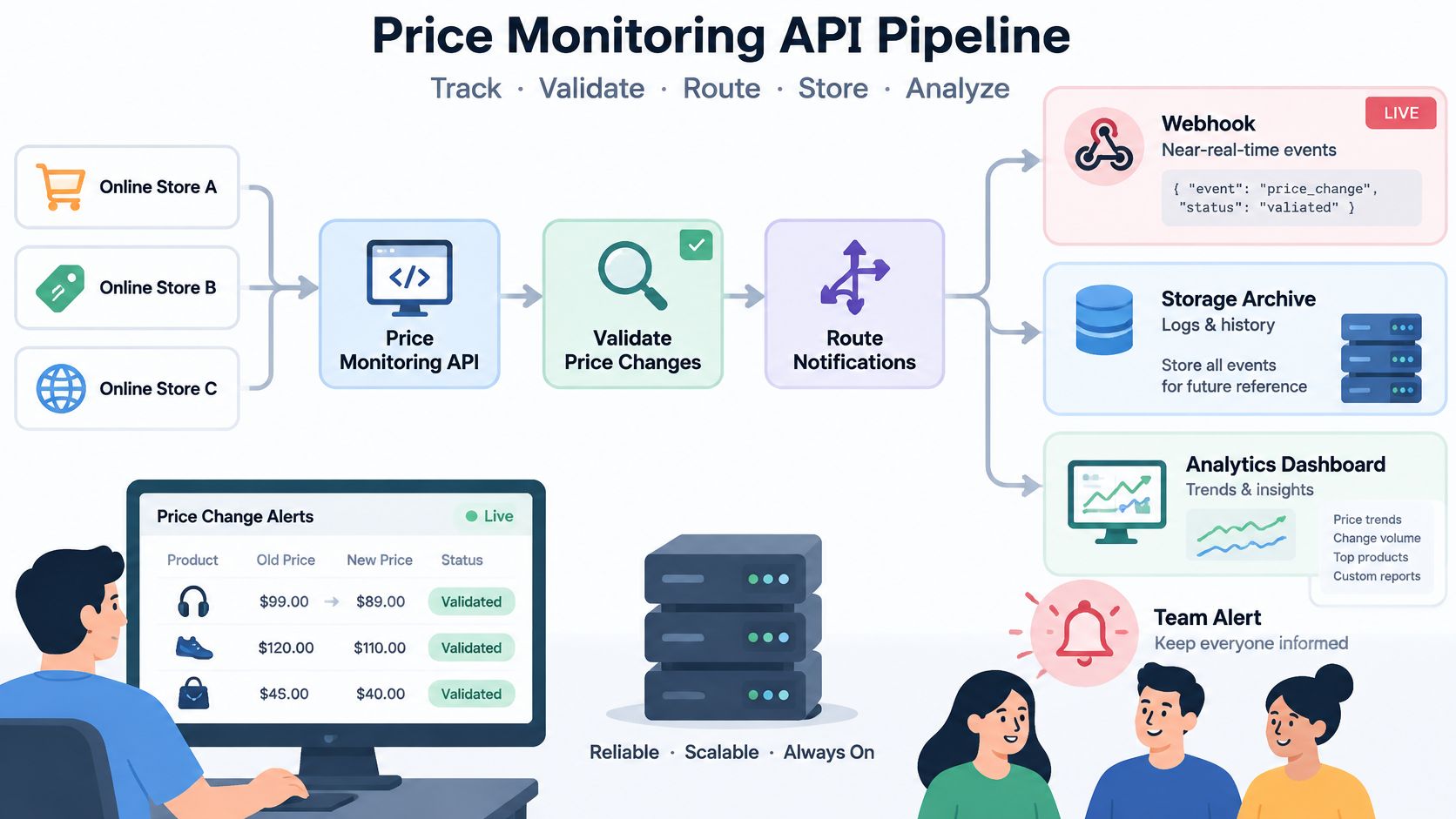
Make events actionable and replayable
A webhook payload should carry the event identifier, offer identity, old and new normalized values, absolute and percentage deltas, location, confirmation status, observation timestamps, and evidence references. Include the rule version that authorized publication.
Sign deliveries, retry temporary receiver failures, and require consumers to handle duplicate delivery. Store delivery attempts separately from the price event so a webhook outage doesn't corrupt the commercial history.
Use distinct storage for observations, confirmed events, and delivery records. Apply retention policies to raw evidence with audit needs and data minimization in mind.
For analytics, calculate a rolling median of valid comparable observations rather than treating the latest raw value as the baseline. Research on competition-based dynamic pricing emphasizes deciding which competitors matter and whether to respond, rather than assuming every observed competitor price is influential.
Keep stockouts outside numerical price comparisons. An absent offer changes the available choice set; it isn't a price of zero or evidence that a competitor became expensive.
The accompanying video offers another view of the monitoring workflow.
Watch the video on YouTubeOptimize for trustworthy actions
In a Gartner survey of 303 U.S. consumers, 68% felt taken advantage of by dynamic pricing, according to reporting on consumer attitudes toward dynamic pricing. That's a reason to evaluate customer-facing consequences, not just detection speed.
Use hysteresis, with different entry and exit conditions, to prevent repeated alerts around a boundary. Require human approval for consequential repricing and enforce margin constraints before any downstream change.
Operational takeaway: A monitoring alert should explain why someone should investigate, not imply that matching the competitor is automatically correct.
Measure alert precision, missed meaningful changes, stale-data rate, match accuracy, and alert-to-action conversion. A busy notification channel isn't evidence of useful intelligence.
Compliance Checks and Your Next Step
Publicly visible offers and account-specific prices deserve different collection policies. Technical accessibility doesn't settle whether a collection method or downstream use is appropriate.
The FTC's surveillance-pricing inquiry examined intermediaries' use of information such as location and personal characteristics to tailor pricing, as discussed in Analysis Group's examination of surveillance pricing. Treat unexplained contextual differences as a reason for investigation, not proof of unlawful behavior.
Make approval part of the workflow
Before enabling a target, document the collection boundary and the person responsible for approving it.
- Review site terms and access rules with appropriate legal guidance for the relevant jurisdiction and use.
- Limit the collection scope to publicly visible information approved for the monitoring purpose.
- Avoid personal account data unless there's a clear basis, authorization, and documented handling policy.
- Record collection methods and material configuration changes in an audit trail.
- Gate consequential actions so a qualified reviewer can evaluate customer-facing pricing decisions.
Don't let debugging practices undermine those controls. Raw pages can contain more information than the fields you intended to extract, so evidence storage needs access restrictions and deletion rules too.
Start with a bounded pilot
Choose a small, representative product set across a limited location panel. Include straightforward listings, a variant-heavy page, and an offer with conditional pricing so the pilot tests failure handling rather than only the easiest extraction path.
Build the observation schema before expanding coverage. Run the pipeline long enough to inspect repeated observations, deliberately review quarantined records, and manually assess a sample of confirmed alerts.
Keep repricing disabled during that evaluation. Decide whether the system produces defensible comparisons by checking precision, freshness, matching quality, and whether recipients act on its alerts.
Assign ownership for parser failures, unresolved context differences, and stale coverage before scaling. You're ready to expand when the team can explain both why an alert fired and why a suspicious observation didn't qualify.
Scrappey offers a web data access API with direct HTTP collection and browser automation, making it an option for the collection layer while your team retains validation and decision logic. Visit Scrappey to evaluate it against your pilot pages, then connect the returned evidence to an auditable observation pipeline before enabling pricing actions.


