
Web Scraping APIs

Best Scraping API for Financial Data

By the Scrappey Research Team

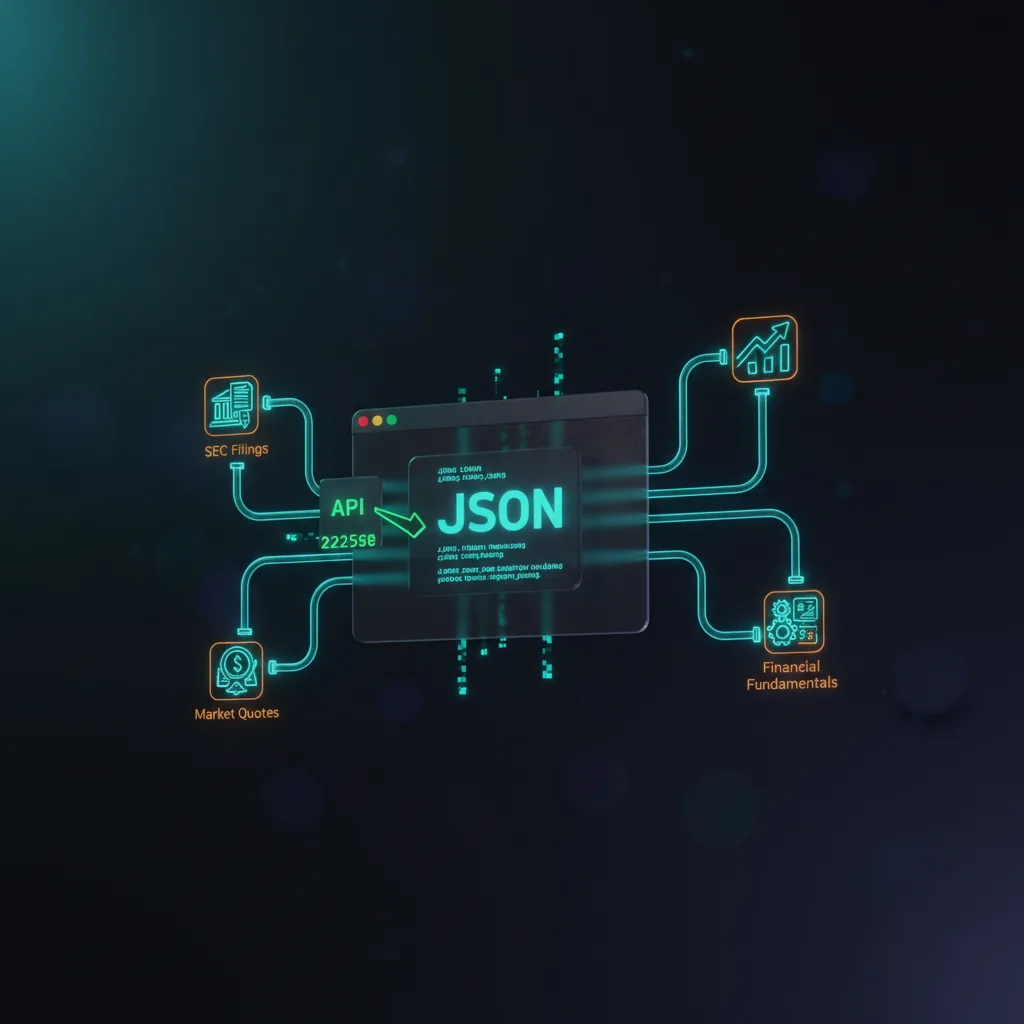
Best Scraping API for Financial Data — conceptual illustration
On this page

For public financial data, the best source is usually an official data API such as SEC EDGAR for filings, Alpha Vantage or Finnhub for quotes, and the Financial Modeling Prep API for fundamentals; a general web scraping API is the right tool only when the data lives on a public page with no usable API. A web scraping API is a service you call over the web to fetch pages for you, handling proxies, browser rendering, and retries in the background. Financial data is unusual because so much of it is already published through free or low-cost official endpoints, so the first question is not which scraper to use but whether you need to scrape at all. This page is educational and not investment advice.

Quick facts

Best for filingsSEC EDGAR JSON APIs (data.sec.gov) - free, official
Best for quotes/fundamentalsAlpha Vantage, Finnhub, Financial Modeling Prep
When to scrapePublic page data with no official API or licensing path
EDGAR rate limit10 requests/sec/IP; descriptive User-Agent required
CompliancePublic data only; respect ToS and data licensing terms

Prefer an official API before scraping

For financial data, reach for an official API first, because most of what teams want is already published in clean, structured form. The U.S. Securities and Exchange Commission serves filings through free JSON endpoints on data.sec.gov: /submissions/CIK##########.json lists every filing a company has made, /api/xbrl/companyfacts/CIK##########.json returns every structured fact a filer has reported (revenue, total assets, shares outstanding, and hundreds more), and /api/xbrl/companyconcept/CIK##########/us-gaap/{tag}.json returns one metric across all periods. The CIK (Central Index Key, the SEC's per-filer ID) is zero-padded to ten digits in the URL. For prices and fundamentals, Alpha Vantage, Finnhub, EOD Historical Data, and Financial Modeling Prep all expose REST endpoints for quotes, historical OHLC bars, earnings, ratios, and company profiles. An official API gives you a stable contract, documented fields, and a clear licensing position - things a scraper of a rendered page cannot match.

When scraping a public page is the right call

Scrape only when the data sits on a publicly available page and there is no official API or affordable license that covers it. Common real cases: a regulator or exchange that publishes notices, halts, or corporate-action calendars as HTML tables but offers no feed; an investor-relations page with figures not yet in a structured filing; or a niche data point an aggregator does not carry. In those cases a general web scraping API fetches the page, runs any JavaScript needed to build it, and returns clean HTML or markdown. Watch out for the difference between a public page and a licensed redistribution feed - many sites publish prices on-screen but reserve the underlying data under separate terms, so read the site's terms of service and any data-licensing page before building on it. The popular yfinance Python library is a useful illustration: it reads Yahoo Finance's undocumented public endpoints, is explicitly not affiliated with or endorsed by Yahoo, and is intended for personal research, so it is fragile for anything production-grade.

Rate limits, freshness, and DIY vs managed

Match your tooling to how fresh the data must be and how hard the source pushes back. Free official APIs guard capacity with hard limits: SEC EDGAR caps each IP at about 10 requests per second and returns 403 if you omit a descriptive User-Agent header identifying your app and a contact email, while quote APIs like Alpha Vantage's free tier throttle calls per minute and per day. Freshness varies by source - EDGAR filings appear minutes after acceptance, end-of-day price feeds settle after the close, and real-time quotes typically require a paid, licensed plan. On the DIY-versus-managed question: when an official API exists, DIY against it is simplest and cheapest. When you must scrape a defended public page, the trade-off is whether to run your own proxy pool and headless browser or call a managed web data API such as Scrappey that handles proxy rotation, browser rendering, and retries in a single request - useful when one page type out of many needs heavier infrastructure than the rest of your pipeline.

Code example

python
import requests

# Official, free, structured: SEC EDGAR company facts.
# A descriptive User-Agent is required or EDGAR returns 403.
HEADERS = {"User-Agent": "Acme Research [email protected]"}

def company_facts(cik: int) -> dict:
    url = f"https://data.sec.gov/api/xbrl/companyfacts/CIK{cik:010d}.json"
    r = requests.get(url, headers=HEADERS, timeout=30)
    r.raise_for_status()
    return r.json()

facts = company_facts(320193)  # Apple Inc.
revenue = facts["facts"]["us-gaap"]["RevenueFromContractWithCustomerExcludingAssessedTax"]
latest = revenue["units"]["USD"][-1]
print(latest["end"], latest["val"])

# Only when a public page has no official API: fetch it via a
# managed web data API that handles proxies, rendering, and retries.
def scrape_public_page(url: str) -> str:
    r = requests.post(
        "https://publisher.scrappey.com/api/v1?key=YOUR_API_KEY",
        json={"cmd": "request.get", "url": url, "markdown": True},
        timeout=120,
    )
    return r.json()["solution"]["markdown"]

Related terms

Concept map

How Best Scraping API for Financial Data connects

The terms most directly tied to this one. Hover a node to see its neighbours, click to preview, drag to rearrange.

0 terms · 0 connections
You are here · Web Scraping APIs
Building map…

Frequently asked questions

Is it legal to scrape financial data?

Scraping publicly available pages is generally treated differently from accessing private or paywalled systems, but the data on a financial page is often covered by separate terms of service and data-licensing rules even when the page itself is public. Always read the source's terms and licensing page, prefer an official API where one exists, and treat this as general guidance rather than legal or investment advice.

Why not just use yfinance for everything?

yfinance is convenient for personal research because it wraps Yahoo Finance's public endpoints in clean Python, but those endpoints are undocumented and the library is explicitly not affiliated with or endorsed by Yahoo. Yahoo can change response formats or rate-limit aggressive use without notice, so it is fragile for production systems where a licensed, documented API is safer.

How do I stay within SEC EDGAR's rate limits?

Keep each IP under roughly 10 requests per second, always send a descriptive User-Agent header with your application name and a contact email, and download only what you need. If you exceed the limit, EDGAR may temporarily block the IP; access resumes once your request rate drops back under the cap.

Do I need a residential proxy to collect financial data?

Usually not for official APIs - they expect API traffic and authenticate by key or User-Agent, so a plain server connection is fine. A residential proxy (an IP from a real consumer ISP) only becomes relevant when you must scrape a defended public page that treats datacenter IPs as suspicious, and even then a managed scraping API can handle the proxy layer for you.

Last updated: 2026-06-16 · Facts last verified: 2026-06-16