
Your category manager forwards a competitor's product page and asks whether you should match the discount. By the time someone checks the rest of the range, the promotion has changed, stock has disappeared, and your latest market report still describes the previous trading period. You need current evidence, but you also need to know whether that evidence represents anything beyond the pages your team happened to collect.
Web scraping for market research means turning public pages into structured, timestamped observations you can compare over time. The difficult part isn't downloading HTML. It's deciding what each observation means, preserving enough evidence to audit it, and preventing gaps in collection from becoming confident claims about the market.
When Scraping Beats Surveys and Reports
Say a rival cuts prices across a category overnight while your next survey report is still being prepared. A recurring collection job can show which products changed, whether discounts require membership, and whether the cheaper items remain available. A periodic report can't reconstruct those details unless someone captured them.
Scraping works best when the answer lives in observable page fields: price, stock status, promotion text, product attributes, or listing dates. Collect the same fields repeatedly and you get a longitudinal dataset rather than a folder of screenshots.
Alberto Cavallo's NBER working paper used scraped daily prices for approximately 80,000 products across five countries, including the United States, and found that online prices were generally stickier than earlier literature suggested. By avoiding time averaging and imputed prices, the study demonstrated that the collection method can change the conclusion, not just accelerate reporting.
Choose the method around the question
Scraping has a clear advantage for:
- High-frequency tracking. Capture changes between scheduled research reports.
- Product-level detail. Separate regular prices, promotions, availability, and assortment.
- Cross-seller comparison. Apply a consistent schema across selected retailers, regions, or categories.
It loses when you need motives, private transactions, or a defined population sample. Use interviews and surveys to understand why buyers hesitate. Use sales records or transaction panels to measure purchases. Don't infer either from page views or review counts.
Community content is useful for discovering language and problems worth investigating. Find Startup Idea's guide to validate startup ideas through Reddit research offers a useful starting point for that exploratory work, but public discussions aren't a substitute for representative customer research.
Use this comparison of research data collection methods when a project mixes behavioral, transactional, and attitudinal questions.
Decision rule: Does the answer sit on a public page, change faster than your reporting cycle, and require product-level detail? If all apply, scraping is a strong candidate, subject to access and compliance review.
Data Types and the Research Questions They Answer
Use this table by starting with the decision, locating its public evidence, and choosing a collection cadence that matches how quickly that evidence changes.
| Data type | Typical public sources | Research question | Typical cadence |
|---|---|---|---|
| Prices and promotions | Retailer product pages | How do competitor prices and discounts move? | Daily |
| Assortment and availability | Category pages, stock badges | Which products are listed, new or sold out? | Daily to weekly |
| Customer reviews and ratings | Marketplace review pages | What do buyers praise or complain about? | Weekly |
| Job postings | Careers pages, job boards | Which roles and skills are growing by employer? | Weekly |
| Search results and ads | Search engine result pages | Who ranks or advertises for a term, and with what message? | Daily or weekly |
| Real estate listings | Listing portals | How do asking prices and inventory change by district? | Weekly |
| Public company disclosures | Investor relations pages, public filings | What have competitors announced and when? | As published |
| Social and forum mentions | Public posts and forums | Which topics are rising or fading? | Daily |
These cadences are starting recommendations, not universal operating requirements. Increase frequency only when a fresher observation could change someone's decision.
For retail teams, prices and promotions usually offer the most direct route from observation to action. Record currency, package size, eligibility conditions, and the displayed discount alongside the price. Otherwise, a member-only offer can look like an unconditional reduction.
Assortment monitoring needs both discovery pages and product pages. Category pages reveal new listings, while product pages help distinguish a temporarily unavailable item from a discontinued one. Reviews answer a different question: collect the text, rating, publication date, and product association needed to investigate recurring complaints.
Interpret indirect signals cautiously
Job postings describe advertised hiring needs, not confirmed headcount or an approved product roadmap. Deduplicate reposted roles and preserve location and department before interpreting changes in hiring emphasis.
Search results and ads require a fixed collection context: query, language, location, device category, and observation time. Real estate listings need persistent listing identifiers and relisting detection, because a republished property isn't necessarily new inventory. Asking prices also aren't completed transaction prices.
Company disclosures provide attributable announcements. Forum and social mentions provide exploratory signals, but duplicate posts, moderation practices, and highly active contributors can distort the apparent importance of a topic.
Pick the data type tied to the decision on the table, not the largest website you can access. Record why that source can answer the question and what it cannot establish.
Legal, Ethical and Compliance Guardrails
Publicly visible doesn't mean unrestricted use. Access rules, privacy obligations, intellectual property, contractual restrictions, and downstream use all deserve review before collection starts.
Begin with website terms and robots.txt. An ACM study of crawler compliance examines these access signals and their uneven observance, reinforcing why robots.txt is neither a complete technical safeguard nor a universal permission grant. Record the relevant restrictions, respect request limits, and exclude prohibited paths.
Keep this workflow limited to publicly available pages. Don't work around logins, paywalls, or verification restrictions just because browser automation makes it technically possible. Our policy is explicit: Scrappey only supports scraping publicly available data, and users must comply with applicable laws and website terms of service.
Make governance part of the repository
Maintain ordinary, reviewable files alongside the pipeline:
- Purpose register. State the question, intended users, permitted uses, and exclusions.
- Source log. Record terms and robots status, review dates, and access decisions.
- Field allowlist. Permit only the attributes necessary for the research.
- Retention schedule. Assign deletion rules to raw responses, parsed records, and exports.
- Run audit log. Preserve collection settings, parser versions, failures, and approvals.
- Export check. Test for personal identifiers and sensitive content before sharing.
Exclude names, handles, profile images, and contact details at parse time when they aren't necessary. Free-text reviews can still disclose health information or other sensitive attributes, so apply redaction before persistent storage.
Norton Law's analysis of web scraping and privacy guidance discusses European Data Protection Board recommendations to document purpose, query parameters, sources, exclusions, retention, and robots compliance, alongside cautions about indiscriminate collection.
Aggregation and linkage can expose patterns that aren't obvious on an individual page. Reassess a dataset before repurposing it, especially for AI training or identity-linked analysis. This isn't legal advice; have counsel review the jurisdictions, sources, and uses involved.
How to Build the Collection Pipeline Step by Step
Build a pipeline that can explain every reported value. The collection layer should be replaceable without changing your research definitions, product identities, or quality checks.
The process below starts with the decision, not the scraper.
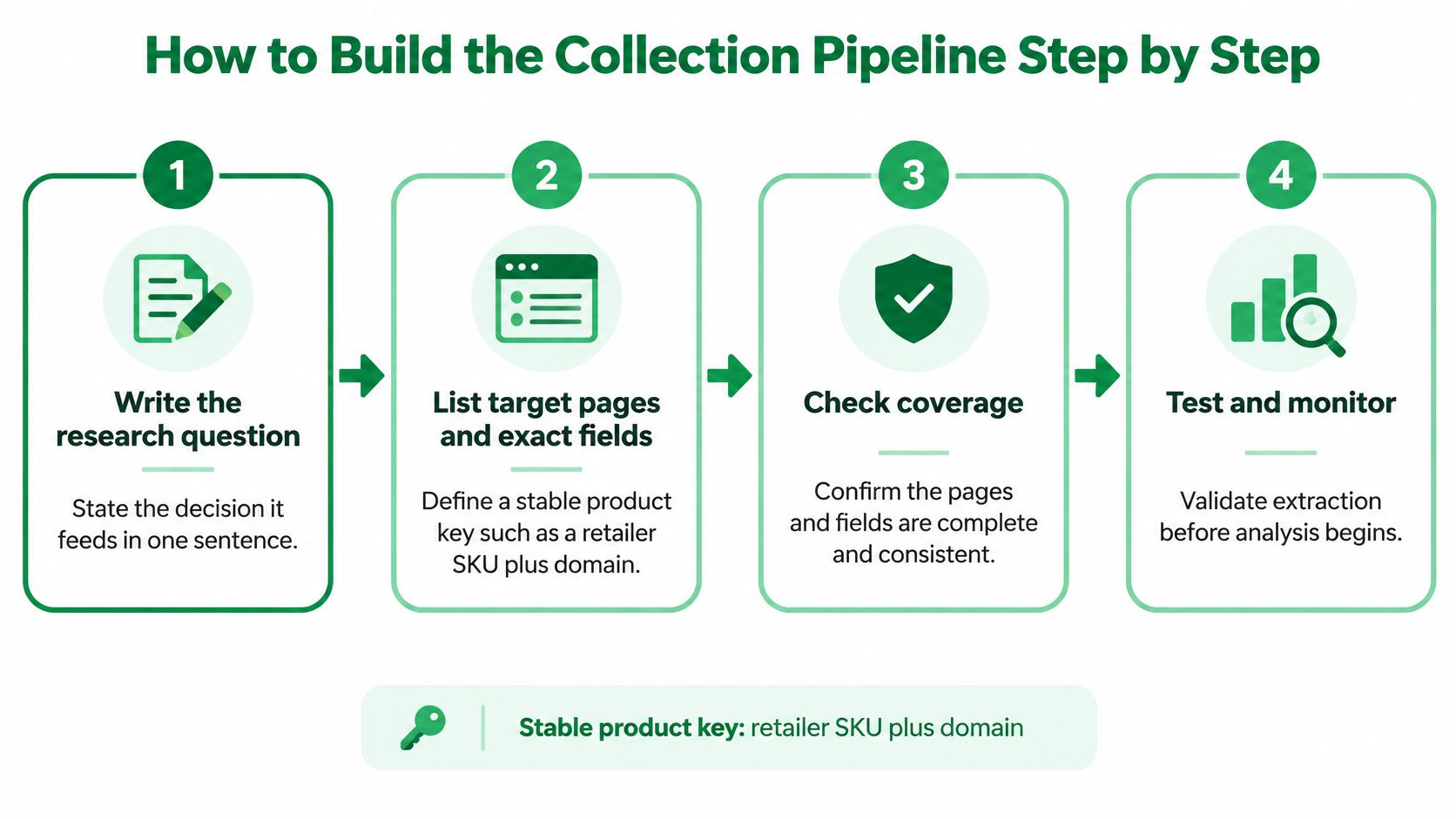
Write the research question. State the decision it feeds in a sentence, such as whether to reprice a matched product range. Specify what finding would trigger action so the project doesn't become open-ended collection.
List target pages and exact fields, then define a stable source key, such as retailer SKU plus domain. Keep cross-retailer product matching separate from that source identity so a revised match doesn't erase collection history.
Review access and choose build versus managed. Record the domain's terms and robots decisions, then estimate permitted request volume and monthly maintenance hours. In-house fetching gives control over headers, proxies, and rendering; managed services reduce that maintenance but introduce request-based costs and provider dependencies.
Choose plain HTTP for static HTML or permitted public JSON endpoints, and a headless browser when required fields arrive through JavaScript. With our Scrappey workflow, you send a request containing a URL to a single endpoint; we run a real browser through a residential IP and return JSON containing status, full HTML, cookies, and LLM-ready Markdown.
Set cadence and concurrency per domain. Use separate queues so a slow source doesn't stall unrelated work. Cache stable pages and avoid refetching content that cannot affect the decision.
Parse CSS selectors or JSON paths into a fixed schema with a timezone-aware timestamp. Treat a missing required selector as a validation failure, not a successful record with an empty price.
Preserve auditable evidence. Link parsed records to restricted, short-lived raw responses where permitted. Redact before persistence where necessary, and apply the retention schedule to evidence as well as analytical tables.
Log failures with explicit reason codes, including access restriction, rate limiting, rendering failure, parser drift, and network error. Keep attempted observations separate from extracted records so analysts can inspect what wasn't collected.
Schedule and publish validated output. Load accepted records into staging tables before promoting them to the warehouse or dashboard. Alert on schema drift, stale sources, and unexplained coverage changes rather than every harmless HTML difference.
A minimal extraction sketch
This Python sketch assumes url comes from your approved source inventory. Replace the selector with one tested against that source, and route exceptions into the failure log.
import requests
from bs4 import BeautifulSoup
from datetime import datetime, timezone

response = requests.get(url, timeout=30)
response.raise_for_status()
soup = BeautifulSoup(response.text, "html.parser")
node = soup.select_one("[data-product-price]")
if node is None:
    raise ValueError("required_price_selector_missing")

record = {
    "source_url": url,
    "source_key": source_key,
    "observed_at": datetime.now(timezone.utc).isoformat(),
    "price_raw": node.get_text(strip=True),
    "currency": currency,
    "raw_response_ref": raw_response_ref,
}
Keep price_raw until a separate normalization function validates its currency and numeric format. Don't let locale-specific separators change the value.
For a supplementary walkthrough, use this video alongside your source-specific tests.
Watch the video on YouTubeHandling Blocks, Rate Limits and JavaScript Pages
Don't classify every failed extraction as a block. An empty grid might require rendering, a changed selector might require a parser fix, and a rate limit requires less traffic rather than a different identity.
Classify before retrying. Save the response status, relevant headers, content signature, and parser outcome so you can distinguish access failures from extraction failures.
| Signal | Likely cause | First response | Escalate when |
|---|---|---|---|
| Page loads but product grid is empty | Content rendered by JavaScript | Use headless rendering and wait for the selector | Selector still missing after full load |
| Same content returned across regions | Geo-targeting or cached response | Vary the permitted proxy location and record it | Coverage differs by region in the logs |
| Path disallowed in robots.txt | Site restriction | Exclude the path and log the decision | Never bypass; review the source with counsel |
| Too many requests response | Rate limiting | Honor server retry instructions and reduce concurrency | Limits persist after traffic reduction |
| Access-denied challenge | Access policy or verification | Pause and review permission and terms | Collection requires prohibited circumvention |
| Page loads but required field disappears | Markup or schema change | Compare retained evidence with parser expectations | Source meaning or structure has changed |
Match the remedy to the failure
For transient network failures, use exponential backoff with jitter and a bounded retry budget. Honor a server's retry instructions when present. Don't repeatedly request an access-denied challenge and hope that a different result establishes permission.
Choose network routing to support legitimate collection context. Datacenter connections can suit straightforward public pages; residential routing may be relevant when permitted collection requires a particular geographic vantage point. Neither option removes access restrictions.
Keep session context stable where public pages depend on location or consent settings. Rotating identity on every request can introduce inconsistent currencies, inventories, or experiments, creating apparent market changes that come from your collection setup. Authenticated workflows don't belong in this public-page research pipeline.
For JavaScript pages, wait for a specific product or price selector rather than using a fixed sleep. Set an explicit rendering deadline and record whether the timeout occurred before navigation, after navigation, or while waiting for the field.
A managed fetch layer can take responsibility for dynamic content, rotating proxies, advanced request handling, headless rendering, and verification processing. Your pipeline must still decide whether the returned content is permitted, complete, and analytically usable.
Access principle: Passing a technical challenge isn't permission. Pause when access conditions change, even if your tooling could continue.
Cleaning Data and Checking Coverage Before Analysis
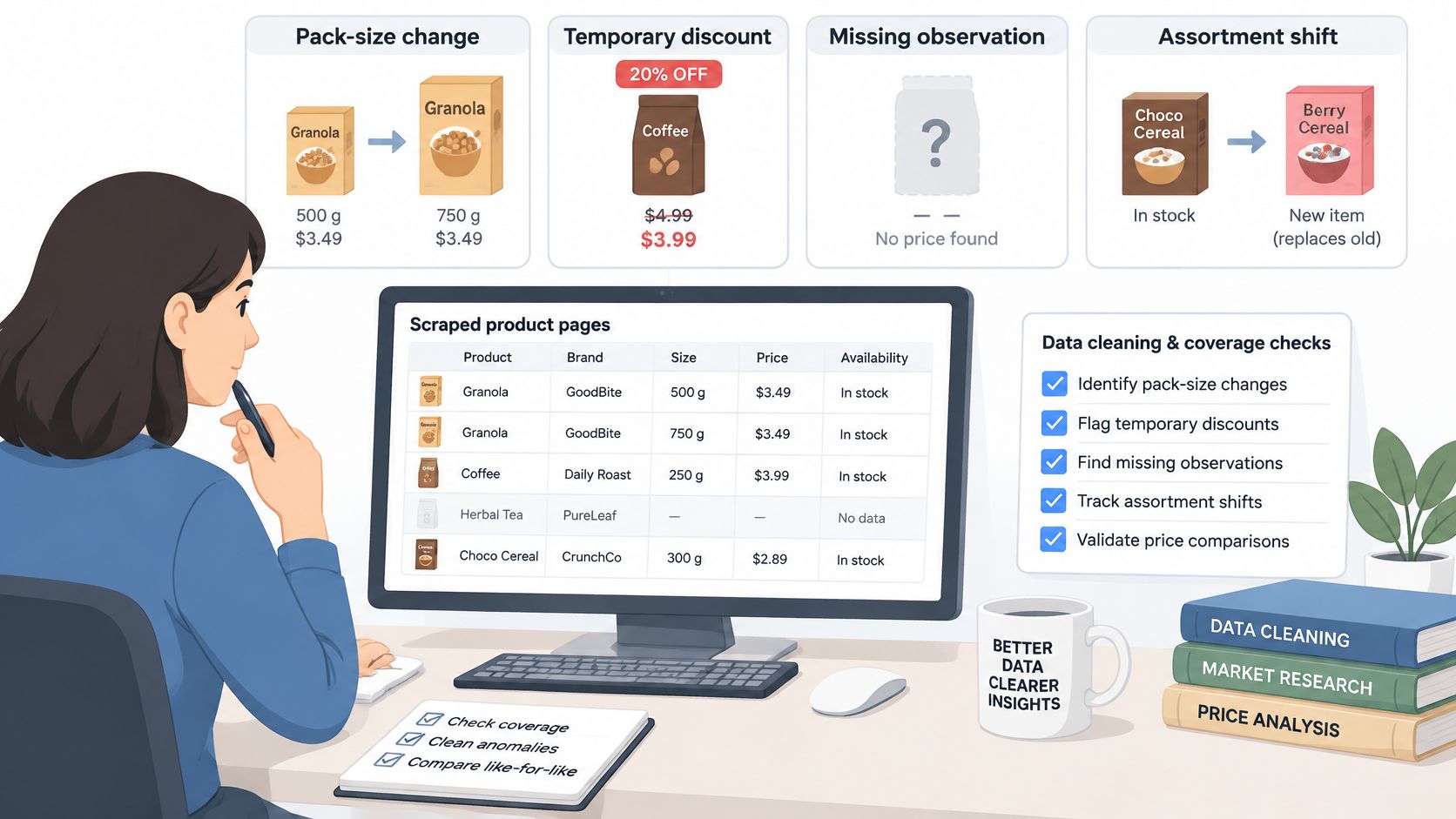
A shelf-price comparison can show stability while shoppers receive less product. A promotional label can disappear without any change in the amount charged. Missing observations can make an expensive product range appear cheaper because those products dropped out of the sample.
A SUERF review of web-scraped pricing data emphasizes the cleaning, normalization, and transformation needed to turn product-specific prices into usable analytical series. Extraction success isn't analysis readiness.
Review the product records and their underlying evidence before approving a trend.
Normalize meaning before comparing values
- Resolve product identity. Match GTIN or EAN codes where available. Otherwise, normalize brand, title, variant, and size, and retain a match-confidence field for review.
- Standardize units. Parse package quantity and measurement units, then calculate comparable unit prices. Keep multipacks distinct from individual items.
- Preserve time context. Store timezone-aware observation timestamps and distinguish them from source publication dates.
- Separate price states. Keep regular, promotional, and conditional prices in different fields.
- Model availability explicitly. Use states such as available, out of stock, not listed, and unknown. Never encode unavailable inventory as a zero price.
For a hypothetical pack-size example, suppose a larger pack is replaced by a smaller pack at the same shelf price. Your price-change detector reports no movement, but the unit-price field rises. If the product identifier also changes, record a replacement relationship rather than pretending the old and new packs are identical.
Publish coverage with the result
Calculate observed target products divided by eligible target products for each source, category, and region. Define eligibility before the run, and keep the denominator versioned so removing troublesome pages doesn't artificially improve coverage.
Distinguish observed out of stock from not observed. A successfully parsed page showing no stock is evidence about availability; a blocked page provides no such evidence. Mixing them corrupts both inventory metrics and collection reporting.
A report's coverage line should name the sources, collection window, targeted products, observed products, and reasons for unobserved records. Include match exclusions and stale observations when they affect the comparison.
Use these data validation methods to turn the checks into acceptance rules. Approve charts only after product matching, unit conversion, price-state separation, timestamps, and coverage pass those rules.
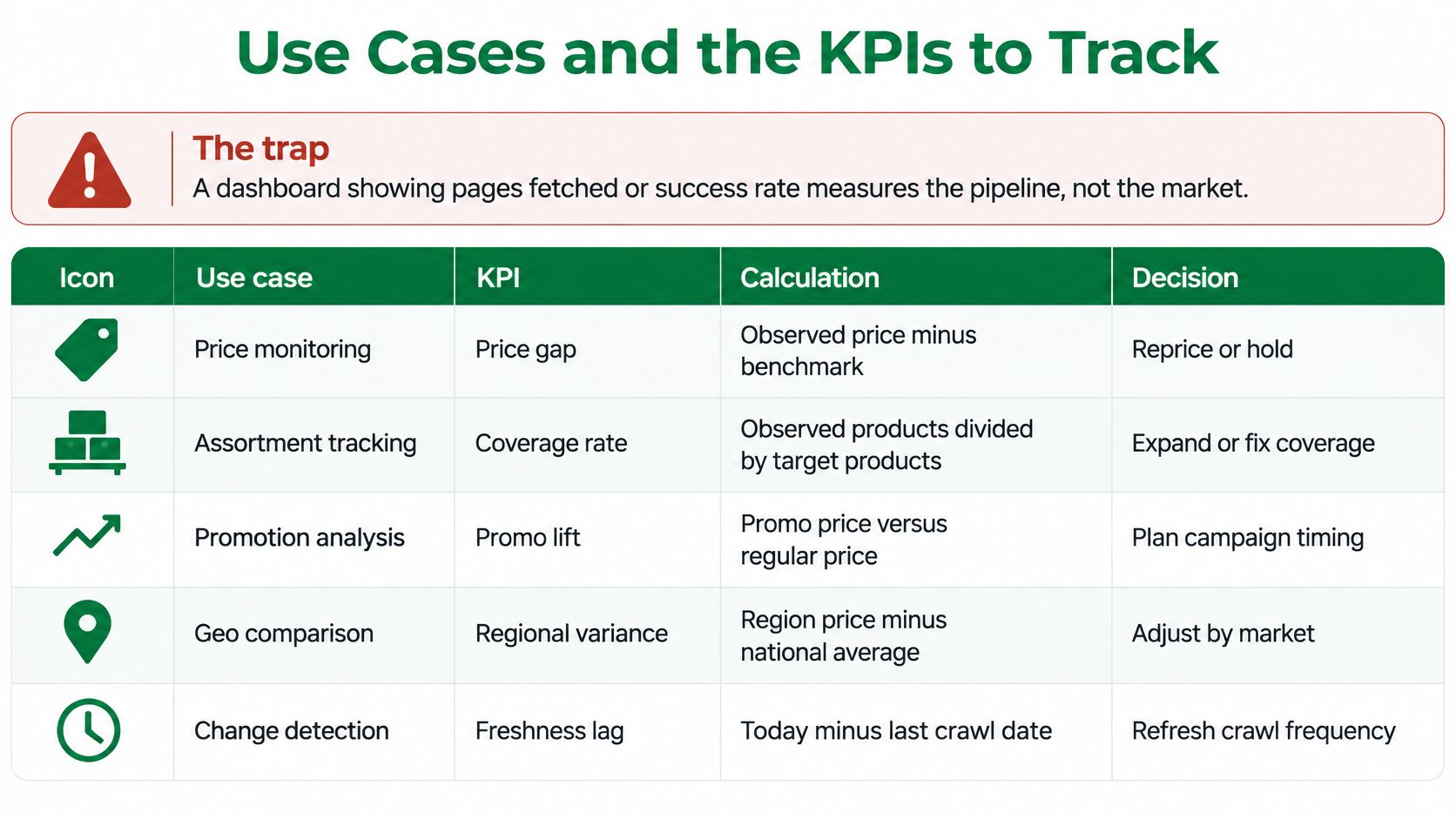
Use Cases and the KPIs to Track
A dashboard showing pages fetched or success rate measures the pipeline, not the market. Business KPIs need a defined comparison set, an interpretable denominator, and a decision owner.
| Use case | KPI | How to calculate | Decision it informs |
|---|---|---|---|
| Price benchmarking | Average price gap vs competitors | Mean matched price difference divided by your price | Repricing and margin review |
| Promotion tracking | Share of tracked SKUs on promotion | Promoted SKUs divided by tracked SKUs | Promotional calendar planning |
| Assortment gap analysis | Catalogue overlap | Shared SKUs divided by total unique SKUs | Range planning and sourcing |
| Market entry scan | Listing coverage | Scraped listings divided by estimated total listings | Whether the dataset is usable for sizing |
| Review sentiment | Negative review share | Reviews in the lowest rating categories divided by all reviews | Product and service fixes |
On a five-star scale, define the negative-review bucket as ratings of one or two stars. For price benchmarking, calculate each matched pair's difference relative to your price before averaging, and state the subtraction direction. Don't describe a promotional price difference as sales lift without transaction evidence.
This visual offers additional operational measures to pair with the business metrics.
Validate who and what the observations represent
A methodological paper on web-scraped data highlights the lack of clear sampling frames and the risks of assuming randomness or representativeness. A technically complete dataset can still omit smaller merchants, languages, regions, mobile experiences, and people who never post publicly.
Before reporting a KPI:
- Define the population. Specify the market you intend to describe and the collection vantage points.
- Inspect its composition. Compare coverage by geography, source type, and relevant product segments.
- Use an external benchmark. Check distributions against suitable official statistics, surveys, or transaction data.
- Report uncertainty. Explain exclusions, benchmark disagreements, and sensitivity to weighting choices.
Weighting is defensible only when the benchmark supports it. Test whether conclusions change when source groups receive different weights or incomplete groups are excluded.
For a pricing implementation, this guide to retail competitor pricing connects comparisons to commercial decisions. Keep the language precise: observed listings aren't market share, and public review sentiment isn't the sentiment of all customers.
Confirm Your Scope Before the First Crawl
Complete a short research brief before writing fetch code. If the team can't agree on the decision or the acceptable coverage, increasing collection volume won't resolve the disagreement.
Keep the brief small enough that the analyst, engineer, and decision owner will review it.
The pre-crawl brief
- Question and decision. Name the uncertainty and the action the result will inform.
- Sources and fields. List target domains, page types, exact attributes, and exclusions.
- Operating limits. Set cadence, retention period, and approved access conditions.
- Ownership and acceptance. Assign an owner, coverage target, benchmark, and stop conditions.
I'd start with a bounded pilot covering a single data type and category rather than an entire competitor estate. Choose a short evaluation window that includes the changes relevant to your decision, and cap the page inventory before collection begins.
During the pilot, measure collection coverage, failure rates by reason code, and differences between scraped and benchmark distributions. Keep failed attempts in the evaluation dataset even when they produce no analytical record. They explain which parts of the intended sample you couldn't observe.
Scale only when coverage holds and the benchmark differences have a defensible explanation. If they don't, change the source selection, matching rules, or research question before adding categories.
This week, choose the data type that matches your most urgent decision, complete the brief, and run that limited pilot. Deliver a coverage statement and failure log with the findings, not just a chart.
We offer 150 free scrapes to start, and failed scrapes are free on Scrappey; confirm current terms before budgeting your pilot. Visit Scrappey to test public-page collection against your approved source inventory, then assess the returned evidence and coverage before expanding your market-research pipeline.