
On popular Amazon products, prices changed 6 to 8 times per day in 2025, according to Marketplace Pulse as reported by the 42Signals summary of Marketplace Pulse findings. That pace changes what a competitor price means. It's not a stable number you can copy once and trust for a week. It's a claim made at a specific time, for a specific offer, under specific conditions, and your job is to verify it before you spend margin reacting to it.
What Retail Competitor Pricing Is and Why It Decides Sales
Start with a result that looks, at first glance, like a stalemate. A 2023 Profitero study compared identical products daily over a three-month period and found that Walmart and Amazon had identical prices on 70% of matched products. In the same study, Amazon was the lowest-priced retailer for the seventh consecutive year, with prices averaging 16% below those of competing retailers, and the average gap between Walmart and Amazon was only 4%.
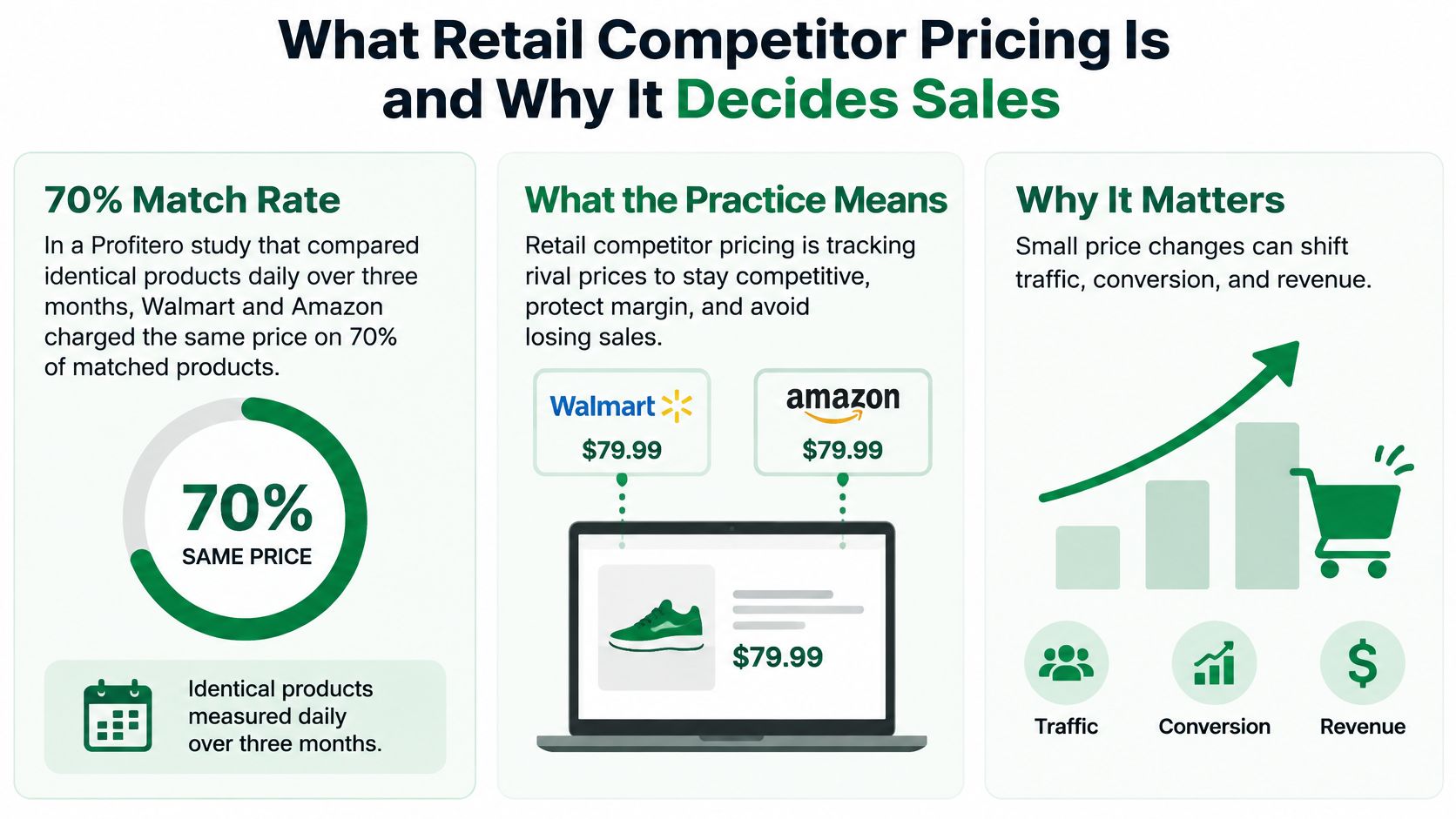
A matched product is the same item, identified tightly enough that you're comparing like with like rather than a lookalike variant. Your price position is where your price sits relative to rivals on those matched items, usually expressed as a gap or an index. With those definitions in place, retail competitor pricing is the ongoing work of tracking what rivals charge for the same or a comparable product, then deciding whether, when, and how far to respond.
Every Shelf Price Is a Standing Bid
Think of each price on your site as a standing bid in a market where a shopper can check a rival in seconds. Say you sell a well-known video game console bundle. Your price isn't being judged on its own. It's being judged against the identical bundle, on the same day, with delivery included, on two or three other sites the shopper already trusts.
That's why the category detail matters more than the headline average. Walmart was 10% more expensive than Amazon in video games, 7% more expensive in fashion, and 5% more expensive in home improvement in that study. An analyst watching only the overall 4% gap would miss where shoppers in a specific aisle see a meaningful difference.
Analyst's rule: Never quote a competitor gap without its category and date range. The average is the least useful number in the dataset.
Three lessons follow directly. Price leadership can persist for years, so don't assume a gap will close on its own. An average gap conceals category variation that decides real baskets. And parity happens item by item, which means your tracking needs product-level matching, category segmentation, and frequent observation rather than a quarterly benchmark.
Five Pricing Postures and When Each One Wins
Matching the lowest observed price on every item is the weakest default you can choose. It treats a possibly flawed observation as an instruction, and it gives away margin on products where shoppers weren't comparing closely anyway. Frame the decision instead as a best response: should you react, to which competitor, by how much, and on which products.
Research published in Management Science built exactly that best-response system using randomized price experiments plus variation from competitor stockouts, and in a five-week live experiment the resulting strategy increased revenue by 11% while maintaining a retailer-defined margin target. The stockout detail matters, because it separates a true price effect from a change in what shoppers could choose at all.
| Posture | Use when | Main risk | Example |
|---|---|---|---|
| Match the lowest offer | Comparable, high-substitution item and the rival is purchasable | Margin erosion and repeated price wars | Repricing a top seller to the lowest rival offer on every visit |
| Selective matching | Comparable products with strong cross-price effects | Needs per-product analysis to run well | Walmart matched Amazon on 53% of products in 2017, not on every item |
| Tolerate a small gap | Low-comparison items where shoppers buy on brand or convenience | Share loss if the gap widens | Keep price and watch the trend for repeated moves |
| Premium value position | Brand, service or delivery justifies a higher price | Shoppers compare more often on the same items | Price on service value and explain the difference |
| Hold and monitor | Rival price looks like a stockout or promotional anomaly | Missed sales if the change is real | Wait for two confirmed observations before acting |
The Rule That Picks the Posture
React only when a matched competitor offer is purchasable, comparable, and economically significant after shipping, promotions, and fees. Then estimate cross-price elasticity, which is how demand for your product changes when a substitute's price changes, rather than relying on the absolute gap. A small gap on a high-substitution item can cost you more than a large gap on an item nobody cross-checks.
Defend highly comparable, high-substitution products. Tolerate gaps on low-comparison items where brand, fit, or convenience carries the sale. Don't copy temporary stockout or promotional anomalies, because you'll be matching a price that disappears before your own change settles.
A premium posture needs evidence shoppers can see, not just internal confidence. Retailers outside pure e-commerce make this explicit with written terms, and furniture and mattress price assurance is a useful model for how a seller states what counts as a comparable offer before a dispute starts. Borrow that discipline: define comparability in advance, in writing.
Assign each product one posture, starting with your top sellers where a gap costs the most. Leave the long tail on hold and monitor until you've got elasticity estimates worth trusting.
Where Competitor Prices Come From and How to Collect Them
Prices come from rival product pages, marketplace listings, retailer feeds or APIs, third-party datasets, and physical store visits. The right source depends on which one shows the price a shopper pays, not which one is easiest to collect. This is a data-quality and demand-modeling problem, not merely a scraping problem, as the expert literature reviewed in the Journal of Marketing Management makes clear when it identifies real-time competitor prices, customer willingness to pay, and product-level price elasticity as core inputs.
| Method | Best for | Main strength | Main limit |
|---|---|---|---|
| Plain HTTP request | Static pages and listing endpoints | Cheap and fast to run at volume | Misses prices rendered by JavaScript |
| Full-browser rendering | JavaScript-heavy sites and location-dependent views | Sees the page a shopper sees | Slower and more expensive per page |
| Retailer feeds or APIs | Retailers that publish structured data | Clean and reliable fields | Often limited to the publisher's own catalogue |
| Third-party price data | Fast market coverage without building collectors | Ready-made breadth | Methodology and freshness vary by vendor |
| Manual store checks | Small samples and one-off audits | No engineering needed | Does not scale and misses timing |
Plain HTTP requests can return a shell page without the price that JavaScript draws on screen, so a cheap collection can be an empty one. Full-browser rendering costs more per page but captures location-dependent views. Our practical guide to web scraping for e-commerce walks through choosing between those modes per target site.
We offer industry-specific solutions for e-commerce, including product data, prices, reviews, and inventory, through a simple HTTP endpoint that works with any programming language that can make a request, including Python, Node.js, PHP, Go, Ruby, Java, C#, and Rust, with no language-specific SDKs required. Our AI Extraction (autoparse) lets you describe fields and receive JSON in exactly the structure you define, without writing or maintaining selectors. Whichever route you take, confirm coverage of your target sites, terms, and data freshness before relying on it. Simsima's approach to eSIM price comparisons is a good reference for publishing a collection methodology openly enough that outsiders can judge it.
Store the Series, Not the Snapshot
Keep every observation as a time series with a timestamp, not only the latest price. That history lets you separate persistent moves from one-off glitches and measure how fast a rival reacts to you. Store the product identifier, seller, availability, promotion type, shipping cost, currency, and collection method with each price, because those fields decide later whether a gap was real.
How to Normalize Prices So Comparisons Are Fair
Here's the failure this procedure prevents: you automate an accurate match against an offer that isn't equivalent. A lower rival price can be a smaller pack, a member-only price, or an out-of-stock listing. Retailer research reported in a Revionics and Chain Store Age white paper found competitor aggressiveness ranked as a top-three pricing challenge for 37% of respondents, while outdated or overly manual processes affected 26%. The same source reports that 82% of U.S. shoppers consider clear pricing and no hidden fees essential, and 20% abandon their carts when fees emerge late, so the displayed price is often not the price that decides the purchase.
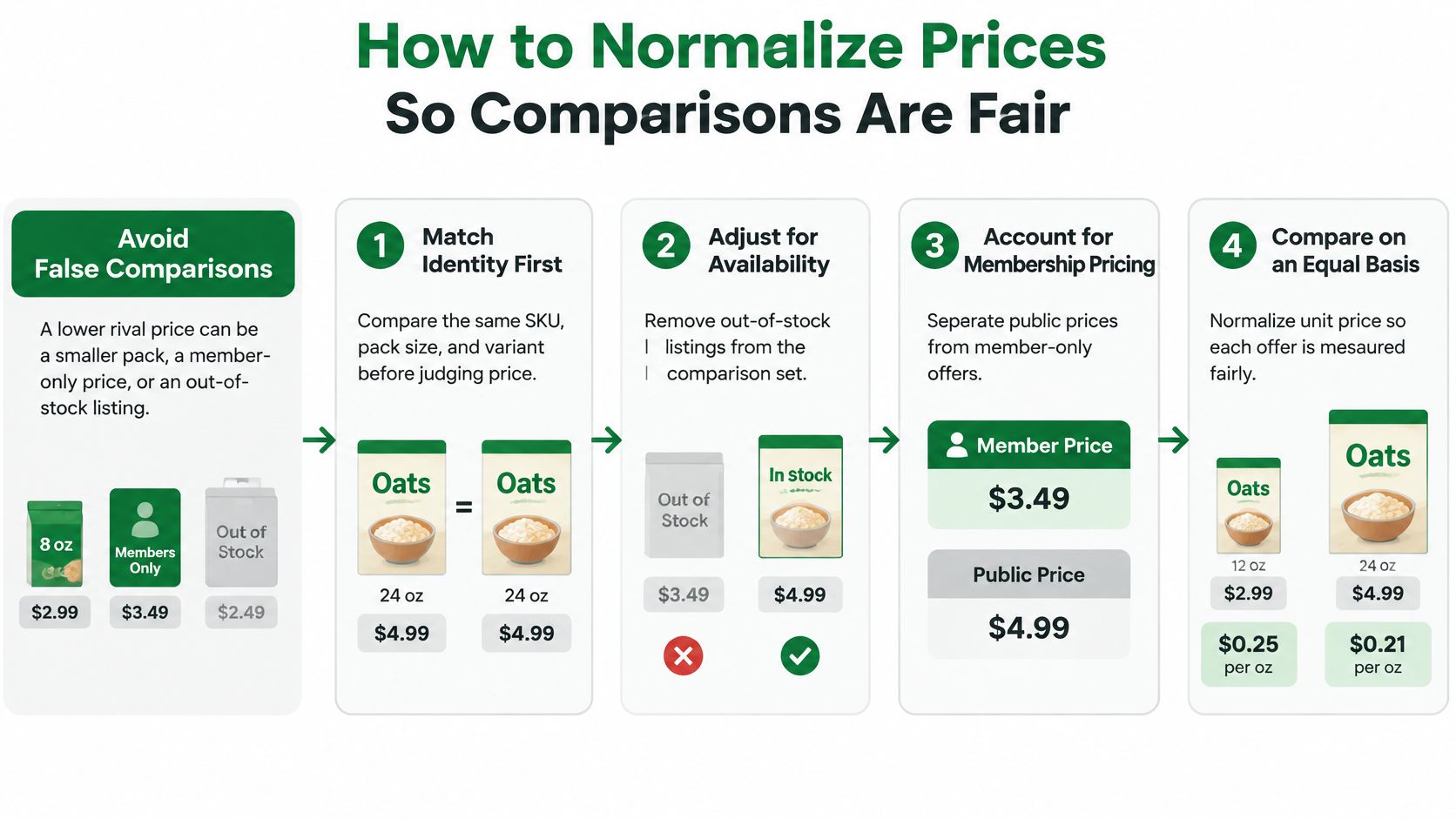
The question is whether it's the same commercial offer, and what the customer's final delivered price is. Work through these steps in order, because each one removes a specific source of false gaps.
Seven Normalization Steps
- Match identity first. Use GTIN or SKU, brand, model, variant, and bundle contents. This prevents treating a near match, such as a different storage size or a bundle without the accessory, as a comparable offer.
- Confirm seller and fulfilment. A marketplace seller and a first-party listing can promise different delivery speeds, returns, and warranty handling. This prevents matching a slow third-party offer as if it carried the retailer's own service level.
- Convert to a landed price. Add shipping and delivery cost, apply tax treatment, and convert currency at a recorded rate. This prevents chasing a headline price that's cheaper only because delivery is charged separately.
- Apply promotions and eligibility. Separate public prices from coupons, loyalty-only prices, and bundle deals, and record the conditions. This prevents matching a price your typical shopper couldn't get.
- Check availability and delivery promise. Mark out-of-stock and long-lead items and exclude them from the reaction set. This prevents cutting price to compete with an offer nobody can buy.
- Calculate a unit price. Express the offer as cost per 100 g, per litre, or per item so pack-size differences disappear. This prevents a smaller pack looking cheaper when it's more expensive per unit.
- Stamp timestamp and confidence. Record when you observed it and how complete the match was. This prevents a stale or partial match carrying the same weight as a verified one.
Our overview of data normalization techniques covers the general field-cleaning patterns behind steps like these. For pricing specifically, keep the raw observation untouched and write normalized values alongside it, so you can audit any transformation.
A normalized price is an argument, not a reading. If you can't show how you got from the displayed price to the compared price, you don't have a benchmark yet.
Finish with three outputs the pricing team can use. You need a matched-price index for category-level position, a competitor price position per product for item decisions, and a confidence score telling each rule how far to trust the comparison. Cross-border teams need the same model with currency, tax, and localization handled explicitly rather than folded into a fudge factor.
Reading a Real Competitor Gap Over Time
Wearable technology tells the story better than any average. A Market Track study conducted for Reuters and reported by Retail Dive examined 213 products in 11 categories over approximately 700 days ending November 7, 2017, and found Walmart moved from 12.6% above Amazon to 6.4% below Amazon in wearable technology. Separate 2017 research in the same report found Walmart matched Amazon's prices on 53% of products, compared with 37% for Target and 35% for Jet.
| Category | Earlier gap vs Amazon | Latest gap vs Amazon | Position change |
|---|---|---|---|
| All matched products (overall average) | 3% above | 0.3% above | Gap nearly closed |
| Wearable technology | 12.6% above | 6.4% below | Moved to a price lead |
| Sports and outdoor | 3.5% above | 1.3% below | Moved to a price lead |
Read the table the way an analyst should. The overall average went from 3% above to 0.3% above, which reads like a near tie and a modest improvement. Underneath it, two categories crossed from disadvantage into a price lead. A team reporting only the average to leadership would have described a retailer standing still while, category by category, it was taking the lead.
What the Average Hid
The near tie also hides how the position was earned. A matched share of 53% tells you this wasn't blanket matching; it was selective. Some products were deliberately left unmatched, which is exactly the posture logic that protects margin.
Before you quote any gap from your own monitoring, state three things in the same breath: the date range, the category, and the matched-item definition. Without those, two analysts can produce different gaps from the same underlying prices and both be arithmetically correct.
Checks to Run on Any Moving Gap
- Did it persist: Confirm the shift across repeated observations rather than a single collection run.
- Does the match still mean the same thing: Check that pack size, variant, and bundle contents haven't changed on either side.
- Was it repricing or a stock change: A rival going out of stock changes the comparison set without any price moving.
- Which products drove it: Decompose the category move into the items with the largest sales weight.
Treat competitor gaps with the same suspicion you'd apply to your own sales reporting. A number without its scope is an anecdote wearing a percentage sign.
Legal and Fair-Pricing Limits Before You Automate
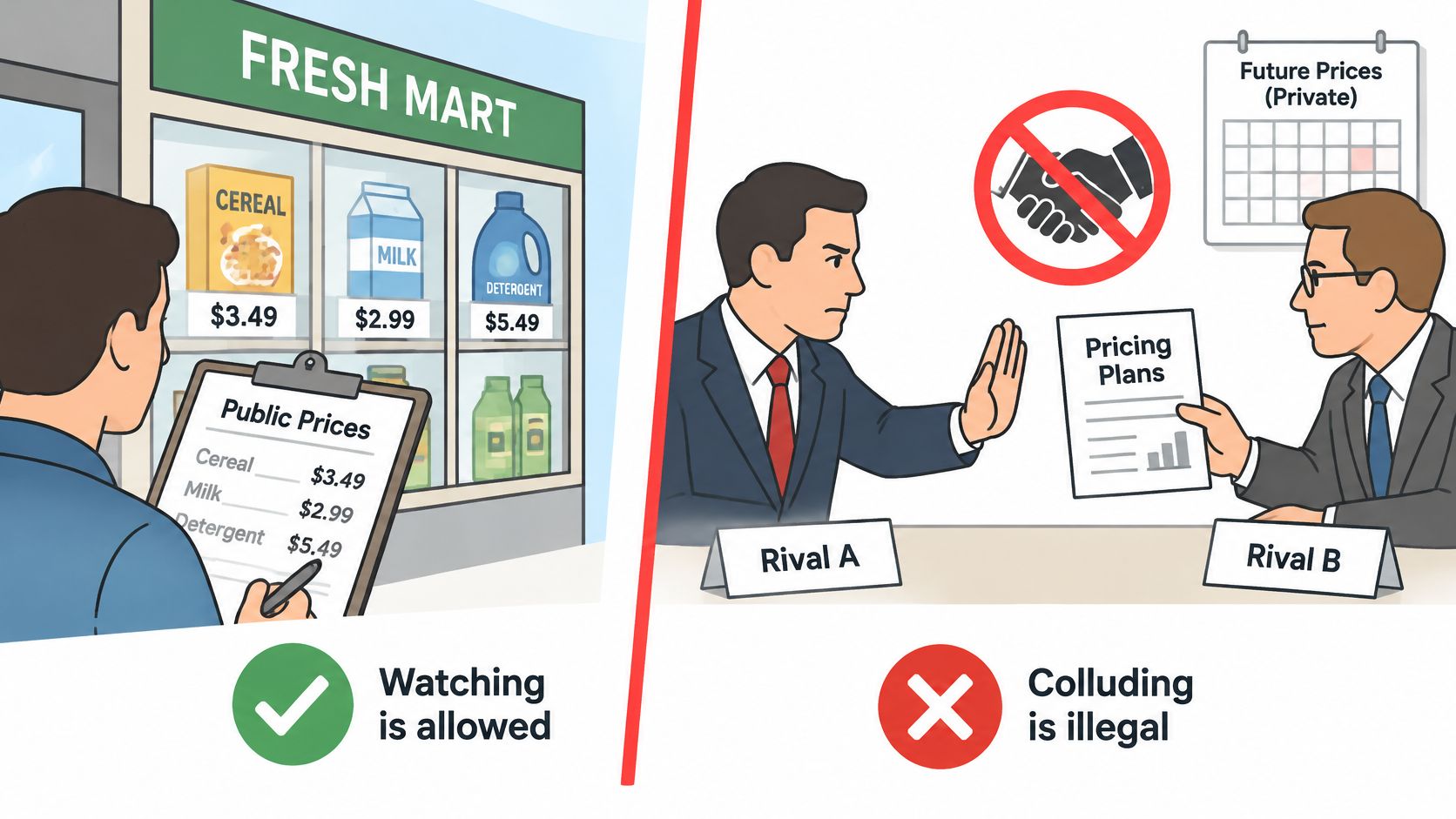
Faster repricing isn't automatically better repricing. Reading public prices is ordinary competitive intelligence. Exchanging future pricing plans with a rival isn't, and that line between observing and coordinating is the one your process must never blur.
Collection has its own rules. Read each site's terms and robots directives before you collect, avoid personal data and logged-in customer-specific prices unless you've got permission, and throttle requests so you don't burden a retailer's systems. Document why you believe your collection method is permitted, because that reasoning is much easier to write before launch than after a complaint.
Fairness Is a Business Constraint
Shoppers judge pricing by legitimacy as much as by level. A 2025 Which? study on dynamic pricing found consumers want transparency about both the use of dynamic pricing and the reasons prices change, and it cites Gartner-reported research finding 68% of surveyed U.S. consumers felt dynamic pricing meant they were being taken advantage of, while 80% considered consistent pricing more trustworthy and 42% would pay more for price certainty. The same report context notes congressional material reporting that nearly 75% of grocery items examined on Instacart were offered at different prices to users purchasing from the same store at the same time.
That last figure should change how you design alerts. If a rival's price is personalized or location-dependent, a single observation isn't the market price; it's one customer's price. Sampling across regions and customer states stops one personalized view becoming your benchmark.
Build the guardrails before the automation:
- Audit trail: Record inputs, rule, and output for every automated change.
- Confidence thresholds: Block reactions based on low-confidence comparisons.
- Human approval: Require sign-off above a set change size.
- Price floors: Enforce minimum margins that rules can't override.
- Plain-language reasons: Store an explanation a customer service agent could repeat.
Our service is for business, commercial, professional, or organizational use only, and users must not be consumers under Dutch or EU consumer protection law, so confirm eligibility before deployment. Rules differ by jurisdiction, and counsel should review both your data collection and your pricing rules before automation goes live.
Before you switch anything on, answer these plainly. Can you prove each comparison was equivalent? Can you explain every change after the fact? Would the change still look defensible if a shopper screenshot it?
Connecting Competitor Prices to Pricing and BI Workflows
Competitor data earns its keep only when it reaches the systems that set prices. Load normalized outputs into your warehouse on a fixed schedule, keeping timestamp and confidence score on every row so downstream models can filter weak comparisons instead of absorbing them.
Your pricing engine should read three inputs per product: competitor price position, the availability flag, and the confidence score. Products below the confidence threshold, or flagged out of stock at the rival, stay at their current price. That hold behaviour is a feature, not a gap in coverage.
Join competitor rows to your own-price sales, inventory, cost, and margin tables. Then estimate elasticity and run constrained optimization that respects inventory levels and minimum-margin requirements. Competitor position alone never sets a price; it changes the price that your own economics would otherwise justify.
For reporting, our roundup of the best tools for business intelligence is a starting point for the dashboard layer. Build four views and review them on a cadence your team can sustain:
- Price position by category over time: Shows where you're drifting before shoppers notice.
- Reaction latency by competitor: Shows how fast each rival answers your moves.
- Share of products holding a price lead: Shows whether your posture choices are landing.
- Margin impact by repricing rule: Shows which rules earn and which ones give margin away.
Route alerts on sudden moves into a review queue rather than straight to a price change. An alert triggered by a personalized or erroneous price is usually a data problem wearing a pricing costume. Log every automated change with the inputs used, so an analyst can reconstruct any decision months later.
Confirm the Rule Before You Change a Price
Put a gate between observation and action. No price changes until the rival offer passes the comparability test and every check below, in order.
- Confidence clears your threshold. The normalized comparison is complete enough to act on.
- The gap persisted. It appeared in at least two observations, so one glitch can't trigger a move.
- The rival can sell it. It's in stock and its delivery promise matches yours.
- Margin survives. The proposed price stays above your minimum-margin floor.
- A human approved large moves. An approver signed off above your set threshold and the reason is logged in plain language.
That last step is where a written promise helps your own team, not just shoppers. The Vinson Fine Furniture price guarantee guide shows how a retailer spells out the conditions a rival offer must meet before it's honoured. Write your internal version with the same specificity, then encode it.
Set monitoring cadence by product importance. Sample high-volume, high-elasticity products most often, sample low-substitution items less, and review the cadence each quarter as your elasticity estimates change. Uniform sampling spends your collection budget evenly across products that don't matter evenly.
Pilot discipline: One category, four weeks, three logged measures: reaction time, margin change, and customer complaints. Scale only if all three move the right way.
Estimate pilot collection cost from published per-request pricing before you commit. We charge one rate per request, with no monthly subscription, no per-seat licensing, and no credit multipliers, and there are no setup fees and no hidden costs, which makes a small pilot budget straightforward to forecast.
Make one decision next: which category enters the pilot. Pick the category where your matching is cleanest and substitution is highest, because that's where you'll learn fastest whether your rules work.
If you're ready to collect competitor prices you can defend, Scrappey gives your team a developer-friendly web data API for gathering product prices, availability, and inventory from retail and marketplace sites, with full-browser rendering for JavaScript-heavy pages. Start with one pilot category, normalize every observation, and build the governed pricing workflow described here on data you trust.