
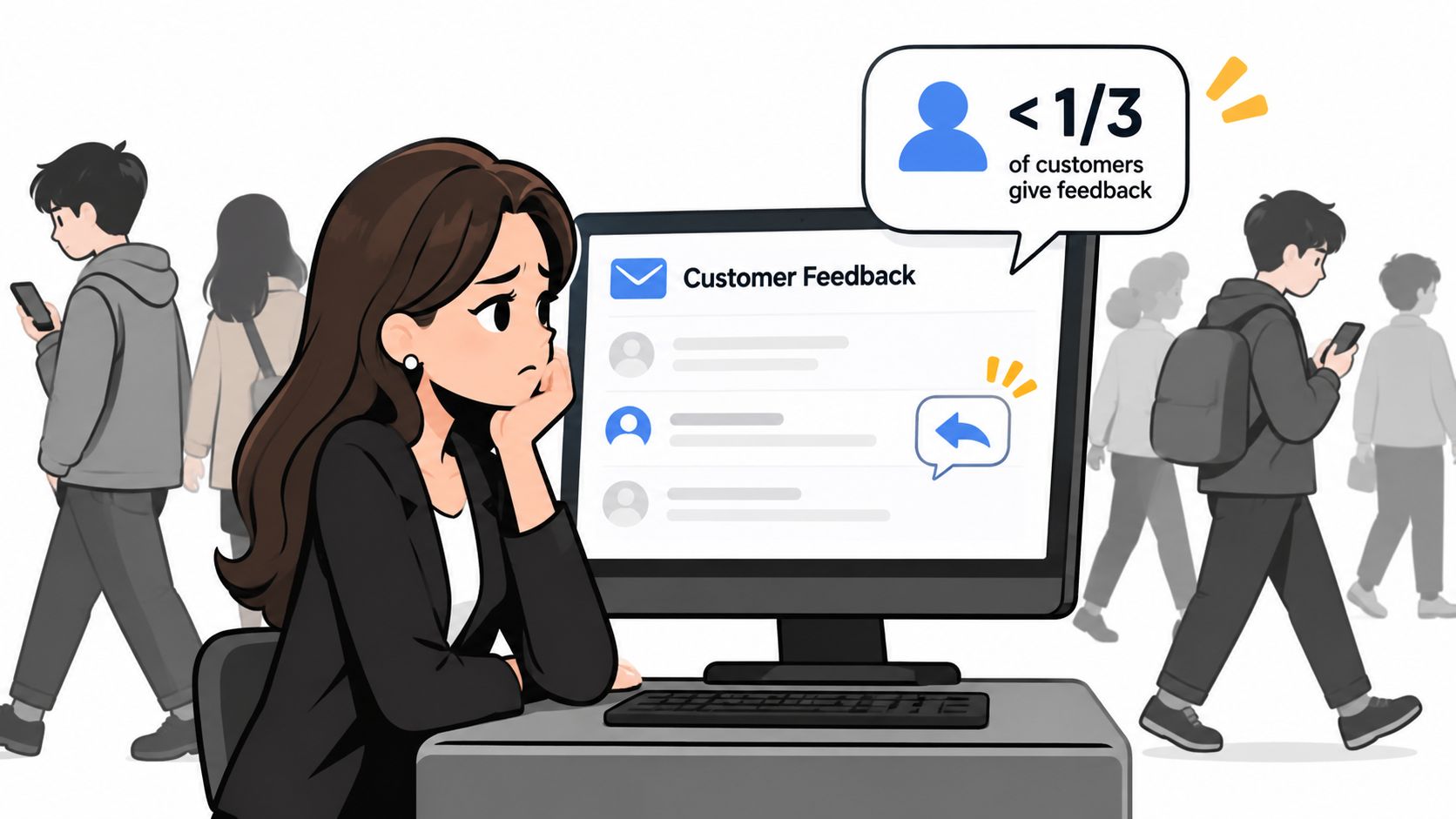
Fewer than one-third of consumers now give feedback directly to companies, and participation has declined each year since 2021, according to Forvis Mazars' analysis of consumer feedback trends. That reframes customer feedback collection: before asking whether satisfaction improved, ask whose experience made it into the dataset.
Why Feedback Misses the Customers Who Matter
A fuller survey inbox isn't necessarily a more accurate sample. If a new invitation mainly attracts frequent buyers, highly dissatisfied customers, or people comfortable answering digital prompts, the resulting score can move without any change in the product.
The missing population matters as much as the responding population. An analyst who reports only completed surveys can't distinguish improving customer experience from a change in who was reachable, eligible, or motivated to answer.
Separate opinion from observation
Treat customer feedback collection as distinct, labeled streams rather than one pool of customer sentiment:
- Invited stated opinion: Ratings and explanations collected through surveys, interviews, and post-task prompts. These answer a defined question among people who received an invitation.
- Public comments: Reviews, forum posts, and community discussions. These reveal language and issues that people choose to publish, without establishing how common those opinions are among customers.
- Behavioral traces: Repeat visits, cancellations, searches, support contacts, and product usage. These record actions, not the attitude behind them.
A cancellation can support an investigation into dissatisfaction. It can't supply a missing satisfaction rating. A customer might cancel because a project ended, a budget changed, or a competing product fit better. Keep observed behavior separate from stated opinion, even when analysts query them together.
The human consequence of a missing population is easy to overlook when a dashboard shows only completed responses.
Define who could have answered
Write the eligible population before launching an invitation. Include the qualifying event, customer status, reporting window, exclusions, and unit of analysis. An account-level relationship survey and a user-level task survey need different denominators.
Then compare respondents with that population using attributes already available for an appropriate purpose. Purchase frequency, geography, device, support history, churn status, and customer value are useful starting dimensions. Don't assume that a missing group resembles the respondents who happen to share its plan.
First quality check: Can you describe the eligible customers who aren't represented, rather than just count the replies you've received?
That question changes operational priorities. If cancelled customers are missing, another prompt inside the active product won't repair the gap. If mobile buyers dominate responses, increasing mobile invitations may improve volume while leaving coverage unchanged.
Choose the channel according to the population it can reach. Keep decisions about channel selection, score comparability, permitted identity joins, and public-review storage explicit. Coverage of the eligible population, not raw reply count, is the first test of whether a score deserves attention.
Channels and the Tradeoffs That Distort Scores
Feedback channels and when their scores must stay apart
| Channel | Best for | Who it over-represents | Pooling rule |
|---|---|---|---|
| In-product prompt | A rating and reason immediately after a task | Active logged-in users | Keep separate from phone and from churned accounts |
| Email survey | Relationship health over a defined period | Motivated repliers with reachable inboxes | Consider pooling only after wording, scale, timing, and mode comparability checks |
| SMS | A short post-purchase pulse | Recent mobile buyers willing to receive messages | Maintain its own series unless comparability is demonstrated; don't merge with interview judgments |
| Phone | Detailed recovery or high-value-account conversations | People willing to talk; potentially higher top-box ratings | Never pool raw ratings with web responses |
| Web form | Support-exit or cancellation explanations | Complainants who find and complete the form | Check coverage and weight against the eligible population where defensible |
| Public reviews | Unsolicited product descriptions and purchase concerns | Self-selected extremes and sometimes non-customers | Never substitute for invited CSAT |
| Forums and communities | Workarounds, recurring questions, and customer language | Enthusiasts and vocal critics | Code themes; don't manufacture a shared star average |
| Support transcripts | Failed or assisted journeys with detailed context | People who contacted support | Compare with successful journeys before setting priorities |
Treat the over-representation column as a bias hypothesis to test, not a universal description of every deployment. An email invitation sent only after successful onboarding has a different selection problem from an email invitation sent to cancelled accounts.
The signal also differs. A task prompt can locate friction precisely but offer little explanation. A support transcript can explain an issue in detail while saying nothing about customers who solved the task without assistance.
A channel change is an instrument change
A telephone-versus-web survey comparison found significantly higher telephone ratings, especially at the upper end of the response scale, consistent with a mode effect on how respondents frame their answers. The interviewer and interaction aren't merely delivery infrastructure. They're part of the measurement conditions.
Say a team replaces an emailed web questionnaire with telephone calls and then reports improved satisfaction. Treat the jump as potentially mode-related until an experiment separates the channel effect from a real experience change. Don't credit the product team for a change the collection team may have introduced.
For a defensible comparison, randomly assign eligible customers to modes while keeping the underlying question consistent:
- Question wording: Preserve the exact request, rather than replacing a neutral question with a conversational paraphrase.
- Scale and order: Keep response anchors and question sequence aligned.
- Eligibility and timing: Ask comparable people at comparable points in their journeys.
- Metadata: Record delivery channel, response interface, instrument version, and collection time.
- Analysis: Examine both participation differences and response distributions before permitting a pooled trend.
An email invitation that opens a web form has both an invitation channel and a response mode. Store both. Otherwise, an analyst may attribute a change to email when the actual change was a redesigned questionnaire.
Choose channels for the operational setting
For a physical service environment, Vendmoore Enterprises' a feedback guide for Oklahoma break rooms provides a concrete setting for thinking about where customers encounter an invitation. Use that context to define the reachable population, not to assume its answers are interchangeable with a digital relationship survey.
Public collection needs a different workflow. The methods in web scraping for market research belong in the public-comment stream, where analysts retain page provenance and examine themes.
A public star rating isn't invited customer satisfaction. A forum participant may not be a customer at all. Combining those records with survey scores doesn't solve missingness. It removes the labels needed to recognize it.
How a Score Becomes a Customer Health Dataset
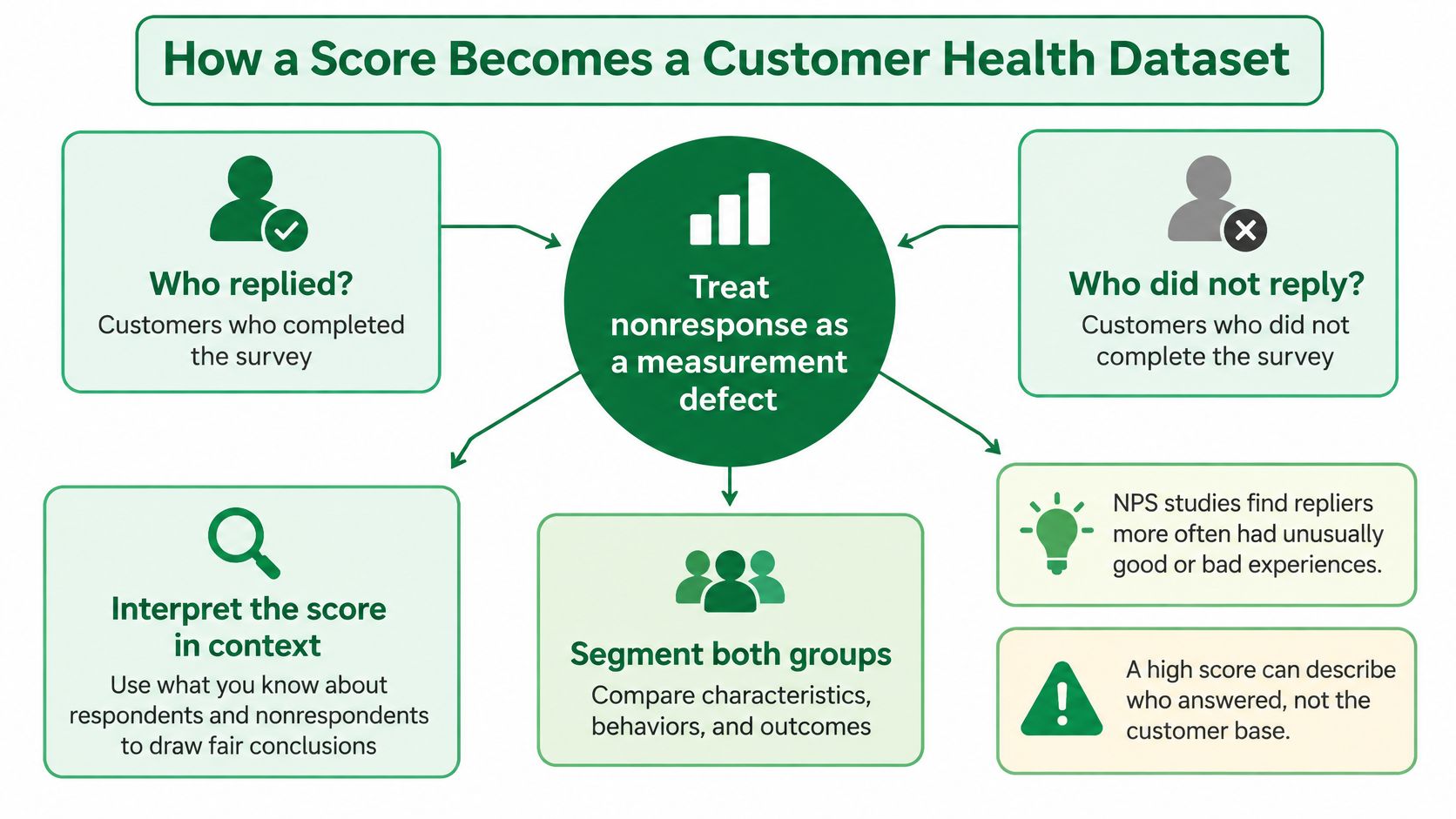
An academic analysis of Net Promoter Score found that respondents were more likely to have unusually positive or negative experiences and weren't necessarily representative of the broader customer population. Nonresponse is a measurement defect, not a shortage of completed questionnaires.
Start with the selection process before interpreting the rating. The important relationship is between the people eligible to answer, the people invited, and the people who replied.
Use this flow to keep those populations visible during processing.
Audit representation before adjusting scores
Create an invitation table alongside the response table. Preserve eligible records even when nobody answers, and distinguish undelivered invitations, delivered invitations, partial responses, and completed responses. Otherwise, the warehouse only contains survivors of the collection process.
For each dimension below, compare its share of the eligible population with its share of respondents.
Coverage check by segment
| Segment | Action |
|---|---|
| Tenure | Weight if the gap is material |
| Plan | Weight if the gap is material |
| Geography | Weight if the gap is material |
| Channel | Weight if the gap is material |
| Product usage | Weight if the gap is material |
| Support outcome | Weight if the gap is material |
| Churn status | Weight if the gap is material |
Use post-stratification when you have defensible population groups and their totals. Use calibration weighting when adjusting to known population margins is more appropriate. Define materiality before reviewing the score, based on whether the imbalance could change the operational decision.
Show weighted and unweighted results together. Preserve weighted versions and inspect large weights, because a small responding group shouldn't alone determine the entire result.
Weighting doesn't reveal the attitudes of a completely unobserved group. If cancelled customers never reply, assigning heavier weights to retained customers won't recover the missing cancellation experience. Repair recruitment or report the limitation.
Connect explanations to outcomes
Store a structured reason code and an open-text explanation with the original response. Trigger invitations after unsuccessful journeys as well as successful ones, including abandonment and unresolved support, where contact is permitted.
Then connect the record to a clearly defined outcome such as renewal, repeat use, escalation, or abandonment. Bluelight's explanation of how roofers track offline conversions provides a useful parallel: define the event and linkage before claiming an outcome relationship.
Validate identity keys, event ordering, duplicate responses, and missing outcomes using explicit data validation methods. A renewal that happened before a survey isn't evidence that the survey predicted renewal.
For a complementary introduction to interpreting customer feedback, use the following video alongside the coverage checks.
Watch the video on YouTubeSet a minimum respondent count per segment according to the precision the decision requires, and show a confidence interval beside each reported segment estimate. Suppress unstable cells rather than letting a small cohort appear authoritative.
Finally, don't assign an individual attitude from a promoter category. Customers in the same category can have different reasons, risks, and intended actions. A category is a reporting device, not a customer diagnosis.
Consent Rules That Keep Feedback Usable
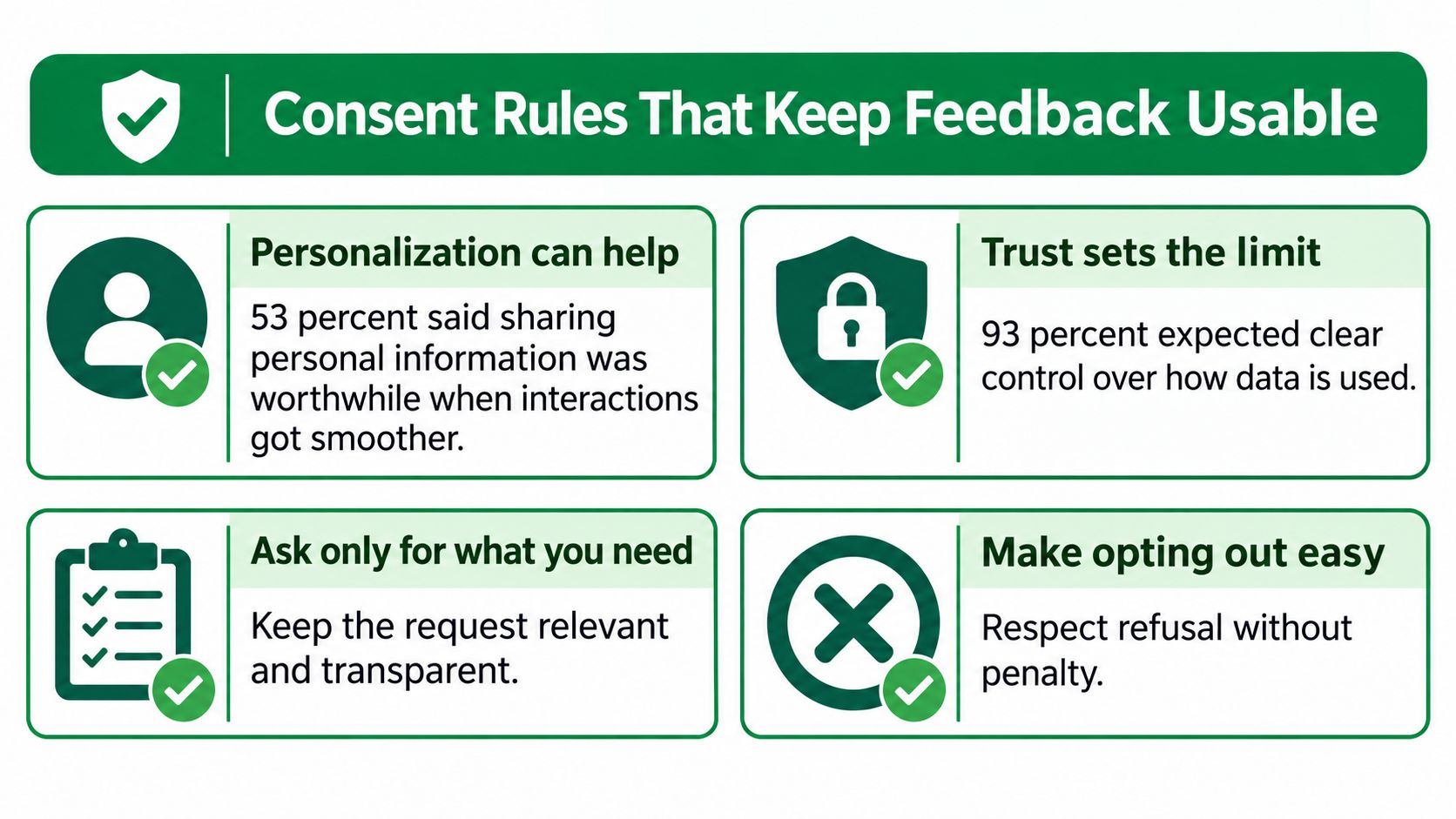
In PwC's 2025 U.S. customer experience survey, 53% of consumers viewed sharing personal information as worthwhile when it made brand interactions smoother, yet 93% said mishandling that data would cause them to lose trust. Relevance isn't permission to combine every available record.
A useful invitation makes the purpose of personalization understandable. Mentioning a recent support case can be relevant; revealing that the company assembled unrelated browsing and public-profile information can make the same invitation feel intrusive.
Separate contact permission from linkage permission
Build separate checks for permission to contact someone and permission to combine their reply with identity or behavioral data. A system that passes the contact check mustn't automatically pass the linkage check.
Apply the distinction to concrete operations:
- Invitation delivery: Confirm the permitted contact purpose and honor channel preferences and refusals.
- Question personalization: Use only the contextual fields needed to make the question relevant.
- Outcome linkage: Verify that the intended connection to renewal, usage, or support records is covered by the applicable permission and processing basis.
- Marketing reuse: Keep research participation separate from promotional targeting and testimonial use.
Use progressive consent where appropriate. Ask for an additional field when the question needs it, rather than presenting a broad request for future unspecified uses. Offer anonymous or pseudonymous routes for sensitive complaints, while explaining any limits on follow-up.
The checklist should sit alongside operational controls, not replace them.
Make permission enforceable downstream
Record the notice version shown, the permitted purpose, relevant preferences, and any withdrawal. Keep those fields accessible to the pipeline that performs joins, not just the application that collected the answer.
Set retention limits for raw responses, identity mappings, exports, and derived tables. Run deletion workflows through the warehouse and downstream copies. Removing a row from the survey application doesn't remove a previously exported file.
Public visibility isn't permission to attach a reviewer's name to a private customer profile.
For public pages, collect the published content needed for the analysis, together with its source and capture time. Avoid identity enrichment merely because a reviewer displays a recognizable name. Keep direct identifiers out of theme reports unless the use requires them.
Before a third-party fetch service processes personal data, complete the relevant processor review and agreement. We're GDPR-compliant and offer a signable Data Processing Agreement for customers who process personal data through our API. We don't retain scraped content beyond the response window needed to return it to the customer.
Those controls don't remove the customer's responsibility for its own storage, lawful processing, or permitted joins. The operational decision remains specific: yes to a personalized invitation when its contact purpose and required fields are permitted; no when the invitation requires an unsupported identity or behavioral join. Send a less personalized version instead.
Metrics Worth Storing Beside the Headline Score
Feedback metrics and the fields that keep them honest
| Metric | Raw value to store | Companion fields | Reporting rule |
|---|---|---|---|
| CSAT | Task score on the instrument's fixed scale | Reason code, task ID, mode | Show the distribution, not only the mean |
| NPS | Original numeric response, not just its category | Tenure, plan, outcome link, scale definition | Show an interval and the detractor, passive, and promoter groups |
| Customer effort | Effort score for a specific task | Task ID, channel, resolution | Don't average across unrelated tasks |
| Public stars | Original rating and source scale | Permalink, date, platform verification flag | Trend by product; never relabel as CSAT |
| Open-text sentiment | Label and supporting text span | Model version, language | Can't replace the numeric score |
| Coverage rate | Respondent count and eligible-population count | Tenure, plan, geography, churn | Alert when the respondent mix drifts |
| Collection mode | Email, SMS, phone, in-app, web, or public, with delivery and response fields where needed | Instrument version, send time | Block pooled trends until tested |
Preserve the instrument, not just the result
The American Customer Satisfaction Index history describes an approach that estimates satisfaction using multiple indicators: overall satisfaction, performance relative to expectations, and closeness to an ideal. Its methodological lesson for an internal dashboard is straightforward: define what you're measuring and repeat that measurement consistently.
Don't treat a relationship score, task score, and public rating as alternate versions of the same variable. They answer different questions. Give each metric its own definition, eligible population, instrument version, and permitted use.
For NPS, retain the response before grouping it. Calculate the headline from the promoter share minus the detractor share, but preserve the underlying distribution so analysts can inspect changes hidden within categories. Store the scale and category boundaries in versioned metric metadata rather than relying on a dashboard developer's memory.
Choose a metric with a decision attached
A support team might brief task-level CSAT because it needs to decide which resolution failures to investigate. A product team diagnosing onboarding might use effort tied to a particular task. A reputation analyst can report public-review themes without implying that they estimate customer-wide prevalence.
Storage rule: Never make the warehouse less informative than the original response.
Keep raw text separate from sentiment labels. If a classifier changes, recompute its output without rewriting what the customer said. Preserve platform verification as a source-provided field, not an analyst's assumption about authenticity.
For a relationship-health program, choose relationship NPS as the weekly briefing metric only when the collection design supports that use. Attach its reason-code distribution and uncertainty, and never drop collection mode or the eligible-population denominator. Those fields determine whether a change deserves interpretation at all.
A Public Review Pipeline You Can Run Weekly
Build this pipeline for public review and forum pages, not invited surveys. Its output is a traceable public-comment dataset that analysts can use to identify issues and investigate product language.
The processing sequence should remain simple enough to audit.
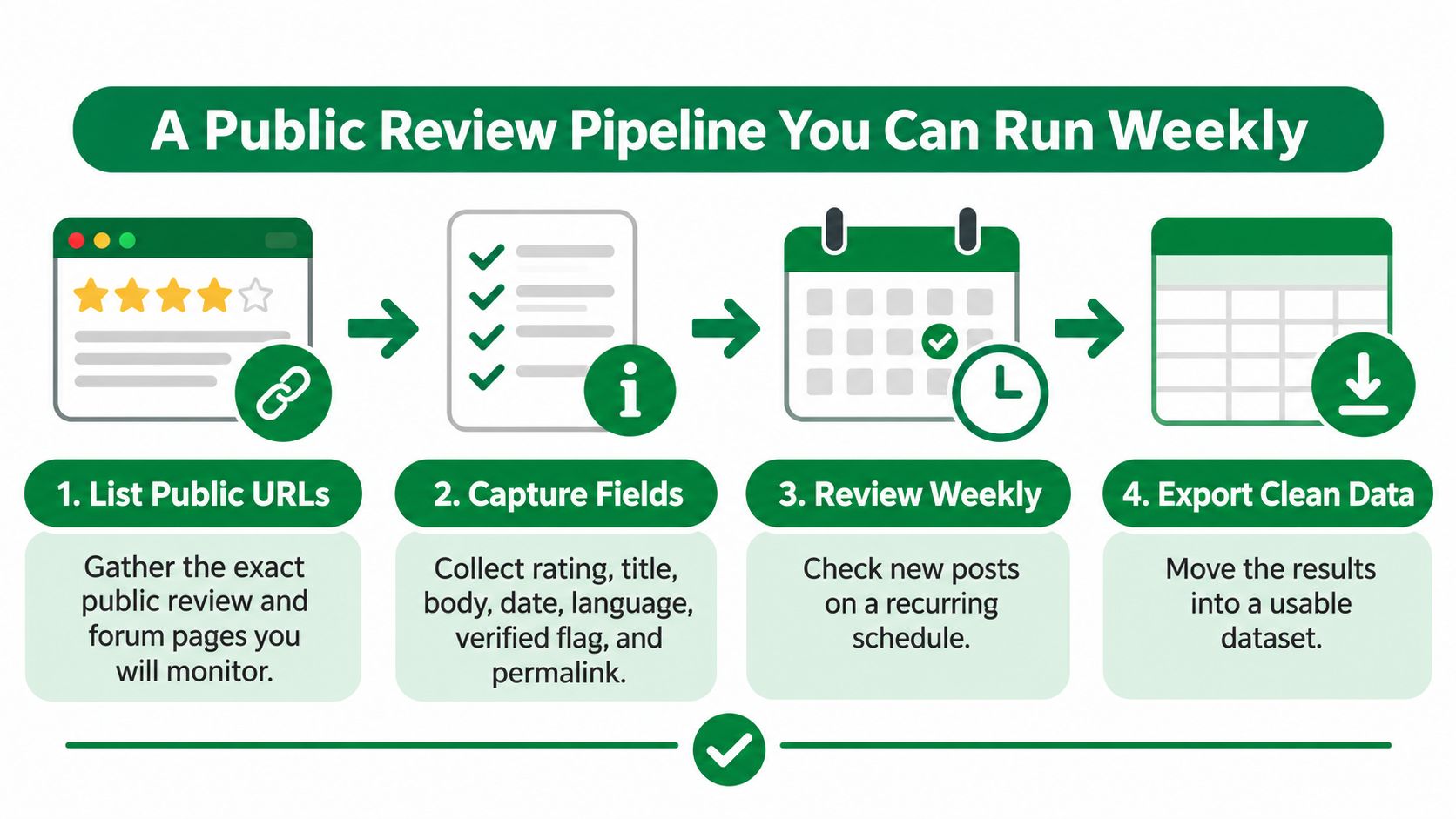
Capture, validate, and deliver
List exact public pages and required fields. Maintain an approved source registry containing the product or forum page, source host, owner, and collection purpose. Request rating, title, body, publication date, language, verification flag, and permalink. Leave absent fields null rather than inventing a rating for a forum post.
Send each approved page to the Scrappey web scraping API, which accepts requests to extract publicly available website data. Use direct HTTP for static pages or suitable API endpoints, and full-browser rendering when JavaScript hydrates the review list. Keep the fetch layer responsible for retrieval, not for deciding what a comment means.
Parse into a stable schema. Normalize returned JSON into typed fields and reject records missing a permalink or usable publication date. Preserve the original date text when parsing is uncertain, and quarantine the record instead of substituting capture time. A changed selector should produce a validation failure, not a convincing empty dataset.
Deliver results to a webhook the warehouse already trusts. Authenticate the receiving endpoint, validate the payload, and upsert on permalink within the appropriate source namespace. Keep an edit history or content hash when an existing review changes. Use the ingestion patterns in building a real-time data pipeline without assuming that public feedback needs continuous collection.
Preserve provenance and stop safely
Attach collection metadata. Store mode as public, plus source host, capture time, parser version, source page, and extraction status. Treat the verification flag as the platform's claim. The Lawyer Guide's explanation of verified client reviews of lawyers is a useful reminder to preserve what verification means at the source rather than converting every badge into a universal authenticity label.
On rate limits or blocked loads, back off, lower concurrency, and retry the same approved page within a bounded retry policy. Don't escalate into aggressive bypass logic. Where appropriate and permitted, reuse a persistent browser profile for session continuity rather than creating a new session on every page.
Quarantine verification challenges. Alert a human when the page requires an interactive challenge, access review, or unexpected login. Stop the automated loop and record the failure reason. A missing collection run should remain visible as missing data.
Keep the public record independent of a customer ID unless the permitted linkage has been established. Don't use name similarity, profile photos, or matching usernames as a shortcut into the CRM.
A worked warehouse handoff
Say an analyst monitors an approved product-review page already in the source registry. A newly published review contains a rating, a delivery complaint, a source date, and a platform verification badge.
The webhook payload carries source_page, permalink, rating_raw, rating_scale, title, body, published_at, language, and verified_flag. It also carries capture_time, parser_version, and mode, with the mode set to public. These are illustrative warehouse fields, not a claim about a required API request format.
The receiving job validates the date and permalink, then inserts or updates the review record. It leaves customer_id empty and preserves the complaint text separately from any assigned theme.
The next morning, the analyst can query new delivery-related comments by product, inspect the supporting text, and distinguish newly discovered reviews from edited ones. A failed fetch appears in the collection-status table, so nobody mistakes a broken parser for a week without complaints.
Start With One Population and One Channel
Start with customers whose accounts reached a renewal decision during a defined reporting window, including those who cancelled. State which accounts are excluded, how multiple users map to an account, and which event determines eligibility. That definition should be reproducible from warehouse records.
Choose email if the team needs a relationship channel that can reach both active and departed customers with appropriate contact permission. Keep the instrument wording, scale, and invitation timing fixed for the initial operating period. Assign an owner who can approve changes instead of allowing small edits to accumulate unnoticed.
Make the first review a release gate
Prepare a short briefing with the following outputs:
- Coverage: Respondents relative to the eligible population, with the missing segments named.
- Score sensitivity: Unweighted and weighted estimates shown together, including uncertainty and the adjustment version.
- Leading reason: The most common coded concern among detractors, supported by the original explanations rather than a sentiment label alone.
If coverage is too thin for the intended decision, withhold the satisfaction headline and brief the coverage gap. If weighting materially changes the interpretation, investigate the recruitment process before celebrating a better score. If the leading reason is ambiguous, improve the codebook before increasing invitation volume.
Public reviews can remain a separate source of issue candidates. When a public theme has no suitable reason code in invited feedback, add a well-defined code and test whether invited respondents recognize the issue. Don't add another collection channel merely to produce more mentions of an already visible complaint.
Give the collection process an owner
The analyst should own population definitions and reporting rules. Engineering should own fetch status, validation failures, delivery monitoring, and reproducible transformations. The customer-experience owner should decide which explanations require investigation and how customers receive follow-up.
Set an escalation path for missing source pages, changed instruments, permission failures, and unstable segment estimates. Each condition should result in a visible status, not an improvised adjustment hidden inside a dashboard query.
Choose a gated launch: release the relationship channel first, and defer the recurring public pipeline until the initial review produces a coverage reading the team trusts. Use coverage, score sensitivity, and the leading reason as the gate. Once those outputs support a defensible interpretation, activate the public stream to investigate additional issues without changing what the relationship score claims to measure.
Scrappey offers Scheduled Jobs that run requests on a cron schedule and deliver each result to a webhook, making a weekly public-review stream straightforward to operationalize. Visit Scrappey to set up collection for your approved public pages, then route the results into a warehouse schema that preserves provenance, collection mode, and validation status.